01
Mobile road service truck
Air, electrical, and hand tooling, common wear parts, lighting, and power
The default unit for most calls — air leaks, lamps, belts, hoses, batteries, and everything that ends on scene.
Need truck repair in St. Paul right now? We run mobile truck repair and road service to wherever your semi stopped, open now and through the night. Most calls we finish where the truck sits, and we tell you straight away if yours is one we can't. The same trucks cover Minneapolis, Bloomington, and Roseville, so a call from outside town reaches the same people.
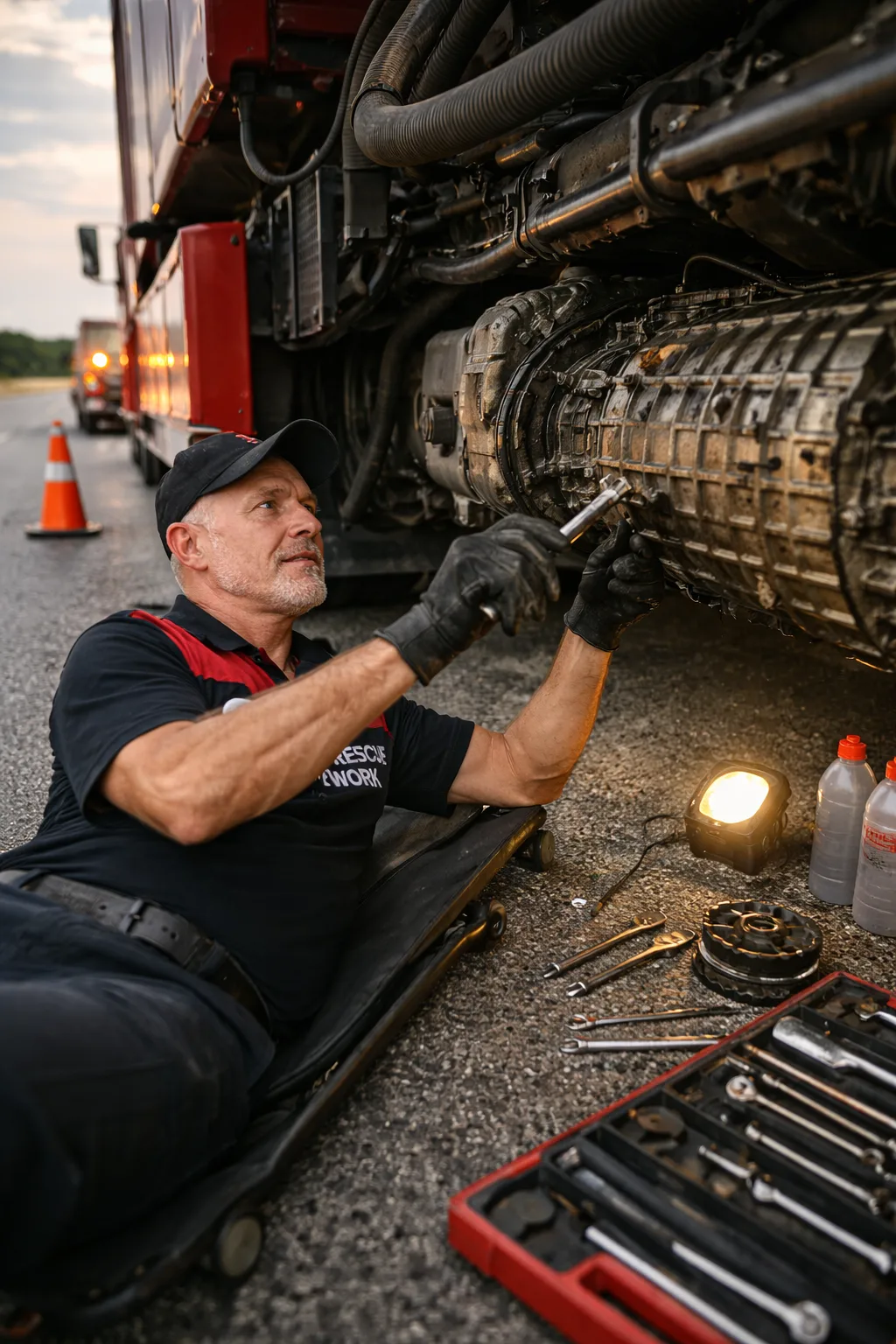
Mobile truck repair is decided by what is on the truck when it arrives. A St. Paul unit carrying diagnostics but no parts makes a diagnosis and a second appointment; the classes below are matched to the fault before dispatch rather than after.
Air, electrical, and hand tooling, common wear parts, lighting, and power
The default unit for most calls — air leaks, lamps, belts, hoses, batteries, and everything that ends on scene.
Manufacturer-level software for engine, chassis, ABS, and aftertreatment ECMs
Check-engine lamps, derates, and no-starts where a generic code reader names a circuit and stops there.
Chambers, valves, slack adjusters, air line and fitting stock, qualified brake inspector
Air system faults and brake defects — the single largest category of roadside truck repair.
Commercial tire changing, inflation, balancing, and torque for steer, drive, and trailer positions
Blowouts and flats, dispatched alongside a repair unit when the call is mixed.
Engine-driven welder, cutting and gouging capability, stock material
Cracked mounts, brackets, and body hardware — see the mobile welding page for what is and is not weldable.
Light through heavy recovery equipment
When the on-scene finding is a shop repair. Frequently dispatched with the service truck so there is no second wait.

One call puts a mobile truck repair unit on the road to you anywhere in St. Paul and the surrounding Ramsey County. Tell us where you are stopped and we do the rest.
The full menu of what our network handles roadside and at partner shops across the St. Paul metro. Expand any category to see the service list for that system.
Roadside diagnostic plug-in and live data review for Cummins, Detroit, Paccar MX, and Volvo D-series engines across the St. Paul corridor.
Cooling-system flush, hose replacement, and thermostat swap on-scene. Common St. Paul summer call from grade-climbing trucks.
Injector swap and lift-pump replacement roadside. Most fuel-related no-starts in St. Paul are resolved without a tow.
DEF doser, NOx sensor, and SCR fault clearing. Long-haul refueling across the St. Paul metro generates frequent DEF-related faults.
Turbo inspection, actuator replacement, and exhaust-leak repair. Heavy load corridors in St. Paul stress turbo bearings; common fall service call.
Clutch adjustment, hydraulic-line repair, and minor transmission service. Major rebuilds route to St. Paul partner shops.
Slack-adjuster, valve, and chamber replacement on-scene. Air-system events are the #1 brake call in St. Paul, especially November-February.
Pad and drum replacement at the shoulder when conditions allow. St. Paul corridor descent grades drive frequent brake-fade events.
Dryer rebuild, compressor inspection, and moisture-trap service. Winter freeze-ups in St. Paul are weekly calls between December and February.
Anti-lock brake faults, sensor replacement, and ECM fault-clearing. Common after long-distance hauls into the St. Paul metro.
Air-bag replacement and ride-height valve service. St. Paul pothole season generates a steady volume of suspension calls.
Shock absorbers, drag link, and steering damper replacement. Important for heavy-duty trucks operating across St. Paul on a daily basis.
Battery test, replacement, and alternator service on-scene. Cold-start failures across the St. Paul metro generate disproportionate winter call volume.
Starter replacement, solenoid service, and battery cable repair. Common St. Paul no-start cause when the battery tests good.
Trailer-cable repair, marker-light replacement, and 7-pin connector service. Required for DOT compliance across St. Paul corridors.
Compressor inspection, refrigerant recharge, blower-motor replacement. Important year-round for sleeper trucks parked overnight in St. Paul.
Body-control module fault clearing, parameter resets, and software flashes when supported. St. Paul dispatch coordinates with OEM dealers as needed.
Auxiliary power unit and inverter diagnostics. Sleeper trucks idling overnight in St. Paul rely on APUs to avoid main-engine fuel burn.
On-scene tire replacement for steer, drive, and trailer positions. St. Paul metro response under 35 minutes; long-haul refueling stops the fastest.
Plug, patch, and inflation service when tire is repairable. Common after construction-debris incidents on St. Paul corridors.
Wheel-end seal, bearing replacement, and oil-bath service when conditions allow roadside. Heavy work routes to a St. Paul-area shop.
Landing-gear repair and crank-handle replacement. Important when the trailer drops a leg in a St. Paul yard or rest area.
Refrigeration unit diagnostics, belt service, and thermostat replacement. St. Paul produce and food-service freight relies on cold-chain integrity.
5th wheel inspection, kingpin service, and air-line repair. St. Paul freight yards generate a steady volume of coupling-related calls.
Road service is labor, travel, and parts against a fault nobody has seen yet, which is why an honest St. Paul quote is a structure rather than a number. Below is what actually moves the invoice, and where the money genuinely goes.
The trip is real cost on a repair that may take thirty minutes. Distance from the responding unit is the largest single variable on a small job and nearly irrelevant on a large one.
Finding the fault and fixing it are separate work. On modern equipment the diagnosis is frequently the expensive half, and a provider who quotes a repair before diagnosing is guessing with your money.
Overnight, weekend, and holiday calls carry a premium. A truck that fails Friday evening costs more to fix than the same truck failing Tuesday morning.
A part on the service truck ends the call. A part that has to be sourced adds a second dispatch, and an OEM-only component on a late-model unit can add a day.
Air brake, aftertreatment, and electrical work on a Class 8 tractor is different labor from the same nominal repair on a straight truck, and specialized equipment carries specialized time.
A yard or a truck stop is a working environment. A live highway shoulder requires scene protection and a slower pace for safety, and some repairs cannot legally or safely be attempted there at all.
Roadside labor rates run above shop rates because the truck, the parts, and the technician came to you. Against that, compare the tow, the shop's queue, and the days the unit is not earning.
The comparison that matters is not repair cost against zero. It is repair cost against a tow plus shop time plus a missed load — which is why a $400 roadside fix routinely beats a $200 shop fix.
We diagnose before we quote the repair, and you authorize the repair before it starts. If the finding is a shop job, you hear that on the phone from the technician rather than after the labor is spent.
The same crews that run St. Paul also cover Minneapolis (8 mi), Bloomington (12 mi) and Roseville (10 mi), so a call from either side of Ramsey County reaches the same desk.
Each service links to local response times, rescuer coverage, and recent dispatched jobs in this metro.
Patterns observed across recent dispatch data in this metro, by service type and corridor.
February 0600, I-494 eastbound approaching the airport split: light snow overnight turned to glazed ice. A loaded flatbed with 3M equipment hits the ice, trailer breaks loose, blocks all lanes. RRN dispatches heavy-duty tow to the nearest exit (Nicollette Avenue) while traffic backs up 4 miles. Road Rescue coordinates with Minnesota State Patrol for lane closure and works the recovery while secondary breakdowns spike across the network.
June midday, US 52 southbound near downtown: refrigerated trailer (frozen foods, dairy) loses compressor drive belt. Temperature climb inside unit threatens $40K cargo. RRN mobile tech reaches the breakdown in 22 minutes with spare belt inventory from Blaine Brothers. Repair takes 18 minutes. Driver continues to distribution center in Lakeville without spoilage loss.
October 1700, I-35E northbound in downtown St. Paul: tandem tractor runs loss of air brakes while merging from 35E to I-94 eastbound interchange. Driver safely pulls onto shoulder. RRN arrives 12 minutes later, diagnoses failed compressor, sources replacement from Universal Truck Parts (Roseville), and completes air brake service roadside in 45 minutes.
April morning, I-494 near Murphy Logistics Fridley facility: heavy goods carrier develops sidewall damage on drive axle tire. Driver limps to nearby exit. RRN mobile tire service arrives with load-rated tire inventory, changes all drive axle tires on-site in 35 minutes. Load continues to warehouse without downtime.
May afternoon, Stone Arch Bridge crossing on US 52: cement truck develops hydraulic line rupture crossing the Mississippi. Driver pulls to designated shoulder. RRN hydraulic specialist arrives in 28 minutes, sections failed hose, installs backup line rated for next segment. Truck clears bridge within 55 minutes to prevent rush-hour cascade failure.
November 0400, I-494 westbound near airport: Amazon freight unit reports engine knock, suspects mechanical timing issue. RRN engine diagnostics unit arrives in 19 minutes, runs full scan, identifies valve wear. Quick valve adjustment restores operation for remaining segment to regional hub. Peak-season delivery timeline maintained.
A repair is not finished when the truck moves. Federal rules decide what has to be recorded, who was allowed to perform it, and whether the unit is legal to dispatch — and a Minnesota carrier is judged on the file, not on the fix.
Carriers must keep a record for each vehicle listing inspections, repairs, and maintenance performed, with dates and identification of the vehicle. A roadside repair is maintenance. An invoice in a driver's cab is not a maintenance record, and the gap between the two is one of the most common findings in a compliance review.
Where a driver reported a defect, the carrier must repair it before dispatching the vehicle again and certify on the report that the repair was made or that none was needed. A repaired defect with no certification on the DVIR remains a violation, even though the truck is genuinely fixed.
A vehicle placed out of service at the roadside cannot move until the defect is corrected. The inspection report carries a section certifying the repair, and it has to be signed and returned. Fixing the truck and ignoring the paperwork leaves the violation open against the carrier.
Anyone who inspects, repairs, or maintains brakes must meet the federal brake inspector qualification standard, and the carrier must retain evidence of it. Because brake and air system faults are the largest category of roadside truck repair, this applies to a large share of road calls.
A commercial driver stopped on the traveled portion or shoulder of a highway must activate hazard lights immediately and place warning devices within ten minutes, positioned according to the road type. This is the driver's obligation before any repair unit arrives, and it is where roadside injuries are prevented or caused.
Every state now has a move-over or slow-down law covering emergency response areas, and most extend to disabled vehicles displaying hazards and to service vehicles with amber lighting. The protection is real and it is also incomplete — which is why a technician may relocate a unit before working on it.
Time spent waiting for and supervising a roadside repair is generally on-duty not driving, and it consumes the driver's available window. A repair that takes four hours can end a driver's day even though the truck is fixed, which is a scheduling fact worth knowing before authorizing a long roadside job.

You get a real time before anyone rolls, and the price before the work starts. No motor club runaround and no waiting on a callback.
St. Paul's freight movement follows I-94, I-35E, and I-494, with additional capacity on US 52 and US 61. Major employers like 3M (medical devices, electronics), General Mills (consumer packaged goods), U.S. Bancorp, Target logistics, and Best Buy distribution generate constant heavy-truck traffic. Weather patterns—deep freeze in winter, black ice on bridge approaches, occasional summer thunderstorms—create predictable breakdown windows. A single mechanical failure or weather incident on I-494 eastbound backing up to the airport affects retail distribution, medical supply chain, and regional trucking for hours.
Saint Paul is the capital city of the U.S. state of Minnesota and the county seat of Ramsey County. As of the 2020 census, the city had a population of 311,527, making it Minnesota's second-most populous city and the 69th-most populous in the United States. Saint Paul and neighboring Minneapolis form the core of the Twin Cities metropolitan area, the third most populous in the Midwest with around 3.7 million residents.
St. Paul sits at the heart of Minnesota's freight corridor where I-94, I-35E, and I-494 converge—the backbone of Midwest distribution. As the state capital and second-most populous city in Minnesota, St. Paul handles everything from 3M healthcare logistics to General Mills consumer goods, with daily heavy traffic crossing the Mississippi River bridges and funneling south through the Blaine Brothers Distribution hub. A breakdown on I-94 eastbound through downtown doesn't just strand one driver; it cascades across the Twin Cities network within minutes.
Winter here is relentless. November through March brings black ice on I-494's eastbound climb toward the airport, and St. Paul's crosstown routes (I-35E, US 52) become slick corridors where lightweight trailers jackknife. The 2020 census recorded 311,527 residents within city limits, but the metro area swells to 3.7 million—making congestion, weather shutdowns, and accident response times critical. Murphy Logistics runs major distribution out of both St. Paul and Fridley; when a Reefer unit breaks down on a temperature swing, you're racing against spoilage across a three-state supply chain.
RRN covers St. Paul's freight ecosystem 24/7: Blaine Brothers Parts in downtown St. Paul connects directly to repair vendors; truck stops at Pilot (Inver Grove Heights), Flying J (Northfield), and TA centers (Hudson, Rogers) feed demand into our vendor network. We staff for the predictable—mechanical breakdowns on cross-town gridlock—and the unexpected: winter pile-ups on the I-94/I-35E interchange, chemical haul incidents on US 52, and high-speed recovery near the airport corridor where Federal Express and Amazon Air operations run continuous freight.
There is no single figure, because a truck repair is labor plus parts against a fault nobody has seen yet — but the structure is knowable before you call. You are paying a service call covering the trip, labor for diagnosis, labor for the repair, and parts. What moves it in St. Paul: distance from the responding unit, whether the fault needs diagnosis or is already obvious, time of day since overnight and weekend calls carry a premium, whether the required part is on the truck or has to be sourced, and where the truck stopped, because a live highway shoulder requires scene protection and slows everything for safety reasons. Roadside labor runs above shop labor, and that comparison is the one people get wrong. The alternative to a roadside repair is usually a tow plus a shop queue plus days the unit is not earning — which is why a repair that costs more per hour routinely costs less in total. Ask for the diagnosis first and the repair quote second, and authorize them separately.
This question is usually asked by someone thinking about starting a mobile repair business rather than someone with a broken truck, so it is worth separating. Outfitting a mobile service truck is a substantial capital exercise: the chassis and service body, an air compressor and reel, a welder or generator, diagnostic software subscriptions per engine manufacturer — which are recurring and expensive — hand and air tooling, lighting, parts inventory, and commercial insurance appropriate to working on other people's equipment beside live traffic. The diagnostic licensing alone surprises most people, because manufacturer-level software is what separates a mobile mechanic from someone with a code reader, and it is not bought once. If instead you meant what it costs to have a mobile mechanic's truck come to you, that is a service call plus labor plus parts, and it is covered in the cost question above. We are not in the business of selling service trucks — we run them.
Most road calls end on scene, and knowing which ones will not is what makes a dispatch honest. Roadside work reliably covers air leaks and air system components, brake chambers and slack adjusters, batteries, alternators and starters, wiring and lighting, belts and hoses, cooling system leaks and thermostats, fuel filters and lift pumps, sensors, forced regenerations and derate recovery, tires at every position, coupling and air line repairs, and cracked mounts and brackets that can be welded. What needs a shop is anything requiring a lift, sustained heat, or a controlled environment: internal engine work, transmission and differential rebuilds, clutch replacement, driveline work, major cooling system components, frame repair in prohibited zones, alignment, and anything on a pressure boundary. In St. Paul the honest split is that the majority of calls resolve where the truck sits — and the value of a good technician is being told immediately, rather than after two hours of labor, when yours is one of the others.
In a metro like St. Paul response is normally measured in tens of minutes rather than hours, but four things decide it and one of them is yours. Ours are how far the nearest suitable unit is, what the fault requires — a tire truck, a diagnostic unit, and an air brake unit are different trucks with different availability — and traffic and weather at the time. Yours is how precisely you describe where you are: road, direction of travel, nearest mile marker or exit, and which side you are on, or better, a dropped pin. Vague location costs more response time than any other single factor, because it produces a unit on the correct highway travelling the wrong way. Storms, the first hard freeze of the season, and holiday weekends generate call volume that stretches everyone's response, ours included, and any provider promising a fixed arrival time during one of those is telling you what you want to hear.
Both, and they are genuinely different work rather than the same work on a different unit. Trailer road service covers ABS faults, brake chambers and slack adjusters, air lines and glad hands, lighting and wiring, landing gear, suspension and air bags, doors and hardware, and cracked crossmembers and mounts. Refrigerated trailers add a whole system of their own — unit diagnostics, belts, fuel and run-dry faults, temperature control and setpoint problems, and the difference between a unit that is not running and a unit that is running and not cooling, which are separate failures with separate causes. In St. Paul a mixed call is common: a tractor fault and a trailer fault discovered together, or a reefer alarm found while dealing with something else. We dispatch for both, and where the work is substantial enough to deserve its own attention, the trailer repair and reefer repair pages go considerably deeper than this one does.
Five things, and having them cuts real time off the call. First, your exact location — road, direction, nearest exit or mile marker, side of the road, or a dropped pin. Second, the unit: year, make, model, and engine, because the engine determines which diagnostic software the technician needs on board. Third, the symptom in the driver's words rather than a diagnosis: what the truck is doing, what warning lamps are lit, what any displayed fault codes say, whether it was gradual or sudden, and whether the truck can still move. Fourth, whether the trailer is loaded and with what, since that changes both the urgency and the options. Fifth, who authorizes the repair and up to what amount — a call that stalls waiting for a fleet manager to answer a phone is the most avoidable delay in road service. If the driver reported the defect on a DVIR, mention it, because the repair has to close that report and not just fix the truck.
Black ice on the eastbound climb toward the airport (MP 48-52) is the primary concern November through March. Lightweight trailers and loaded tandems both struggle on the glazed sections. RRN stations heavy-duty tow capacity strategically to respond within 28 minutes to I-494 corridor calls. Air brake and engine warm-up time are also critical; we carry spare glow plugs and heating line fittings for cold-start failures.
US 52 runs congested through downtown St. Paul, especially during rush (0700-0900 and 1600-1800). RRN mobile units stage near downtown exits and can reach most breakdowns in 22-28 minutes. Traffic congestion is factored into our dispatch algorithm; we route heavy recovery via backroads (Stone Arch Bridge, Fort Road) to minimize additional delays.
Yes. Murphy Logistics (Fridley and St. Paul facilities) moves significant refrigerated loads. RRN partners with specialized refrigeration shops and carries common compressor, condenser, and insulation repair materials. Reefer breakdowns near the I-494/Murphy hub typically resolve in 38-42 minutes, protecting temperature-sensitive goods.
Fuel delivery to stranded trucks on I-494 eastbound is coordinated with Minnesota State Patrol and airport authorities due to hazmat regulations. RRN dispatches fuel units with proper credentials to designated safe zones off the main lanes. Standard fuel calls respond in 24-28 minutes; hazmat coordination may add 8-12 minutes but ensures legal and safe delivery.
St. Paul's winter weather (heavy snow, black ice, wind) creates multi-vehicle incidents on I-94 and I-494 intersections. RRN coordinates with Minnesota State Patrol, pre-stages additional heavy-duty tow and winch recovery units on forecast high-risk days, and provides real-time dispatch updates to freight carriers. Response to pile-up scenes typically takes 18-32 minutes depending on severity and access.
Yes. Universal Truck Parts (Roseville), Blaine Brothers Parts Distribution (downtown St. Paul), and FleetPride (Roseville) are RRN-integrated suppliers. Manders Diesel (Lakeville) serves southern corridor calls. Most common replacement parts (belts, hoses, brake pads, filters) are in stock for 20-30 minute mobile repair windows; rare parts are sourced same-day via overnight courier.
RRN-certified DOT inspectors operate from staging points across the Twin Cities metro. For St. Paul area calls, inspection arrival is typically 38-45 minutes. Pre-scheduled inspections at warehouse or truck stop facilities can often be completed in under 30 minutes. We coordinate with General Mills, Target, and 3M distribution for regular fleet maintenance windows.
Yes. Amazon Air operations near the Minneapolis-St. Paul airport run 24/7 freight schedules. RRN provides priority engine diagnostics, brake system checks, and rapid reefer repairs to keep Amazon units mobile. We maintain a dedicated dispatch tier for airport-adjacent breakdowns with target response under 22 minutes to protect peak-season and time-sensitive loads.
Call RRN dispatch immediately and provide your mile marker, direction, visible symptoms, and truck configuration (tractor-trailer, tandem, etc.). I-35E downtown runs congested; dispatch will route you to safe staging area (shoulder or designated exit) and dispatch the nearest available unit. Average response is 26-34 minutes. Have your carrier account number and insurance details ready.
RRN serves the entire Twin Cities metro (Minneapolis, Ramsey, Hennepin, Carver, Scott, Washington counties) plus extended corridors: I-35E south to Lakeville, I-494 east to the Wisconsin border, US 52 south to Northfield, and US 61 north to Wyoming. Truck stops at Pilot, TA, and Flying J are fully integrated into our network. Response times increase 8-15 minutes as you move into fringe areas but remain predictable and logged.

St. Paul runs about 311,527 people and sits in Ramsey County, inside the Twin Cities Metropolitan Area. We take the call, find the closest crew that actually does this work, and tell you what it costs before anyone turns a wheel.
Coverage in surrounding cities and metros across the same network of verified rescuers.
The same verified network of providers, dispatched 24/7 across every major Minnesota metro and freight corridor.

Whether the truck is sitting in St. Paul or out toward Roseville, it is the same phone number and the same crews. One call, day or night.
Road Rescue Network is actively recruiting verified mobile truck repair providers in the St. Paul metro. Heavy traffic, real fleet leads, no auction race-to-the-bottom, straight rescuer-to-customer dispatch with confirmed pricing.
We send St. Paul mobile truck repair calls directly to verified rescuers in your service radius. Apply once. Insurance & DOT verified. Live dispatch, fleet accounts, transparent pricing, no motor-club shave-down.
Deep-dive guide on choosing the right provider, common pitfalls, and what to expect on a service call.
OpenOpen positions at our network rescuers, full-time, part-time, and 1099 contract.
OpenOn-site photos from recent calls, see the work, not just the marketing.
OpenNetwork technicians carry diagnostic equipment, OEM-spec tooling, and common-failure parts for every major mobile truck repair brand on the road. Out-of-stock specifics order in within 24 hours.
Service trucks dispatch routinely to these locations across the metro freight corridors.


Local parts houses and diesel suppliers used by network mechanics for time-critical roadside repairs.
Major shippers, distribution centers, and industrial freight nodes generating outbound and inbound truck volume.
Three steps from the call to a cleared scene. Same flow whether you call from a fleet desk or the shoulder of an interstate.
Road, direction of travel, nearest exit or mile marker, and which side you are on — then what the truck is doing. Half of St. Paul road service delay is a unit on the right highway going the wrong way, and a dropped pin removes it entirely.
A dash lamp, an air leak, and a blown steer tire need three different trucks. Matching the fault to the unit before dispatch is why a St. Paul call ends on the first visit instead of the second.
Hazards on immediately, warning devices placed within ten minutes, and dispatch will tell you whether to stay belted inside or get out on the passenger side. On a St. Paul shoulder that decision matters more than the repair does.
Network rescuers accept all major credit cards, fleet cards, and consumer payment apps. Confirmed at dispatch.