01
Agricultural tire service truck
Boom or crane for handling, bead breaking capacity for large-diameter tires, ballast pump
Tractor, combine, sprayer, and implement tires in the field or the yard.
Need tractor tire repair in Elwood? We come to the machine — tractor, loader, forklift, or industrial. These are heavy, usually full of fluid, and on wheels that hurt people when handled wrong, so we do them right. The same trucks cover Channahon, Joliet, and Minooka, so a call from outside town reaches the same people.
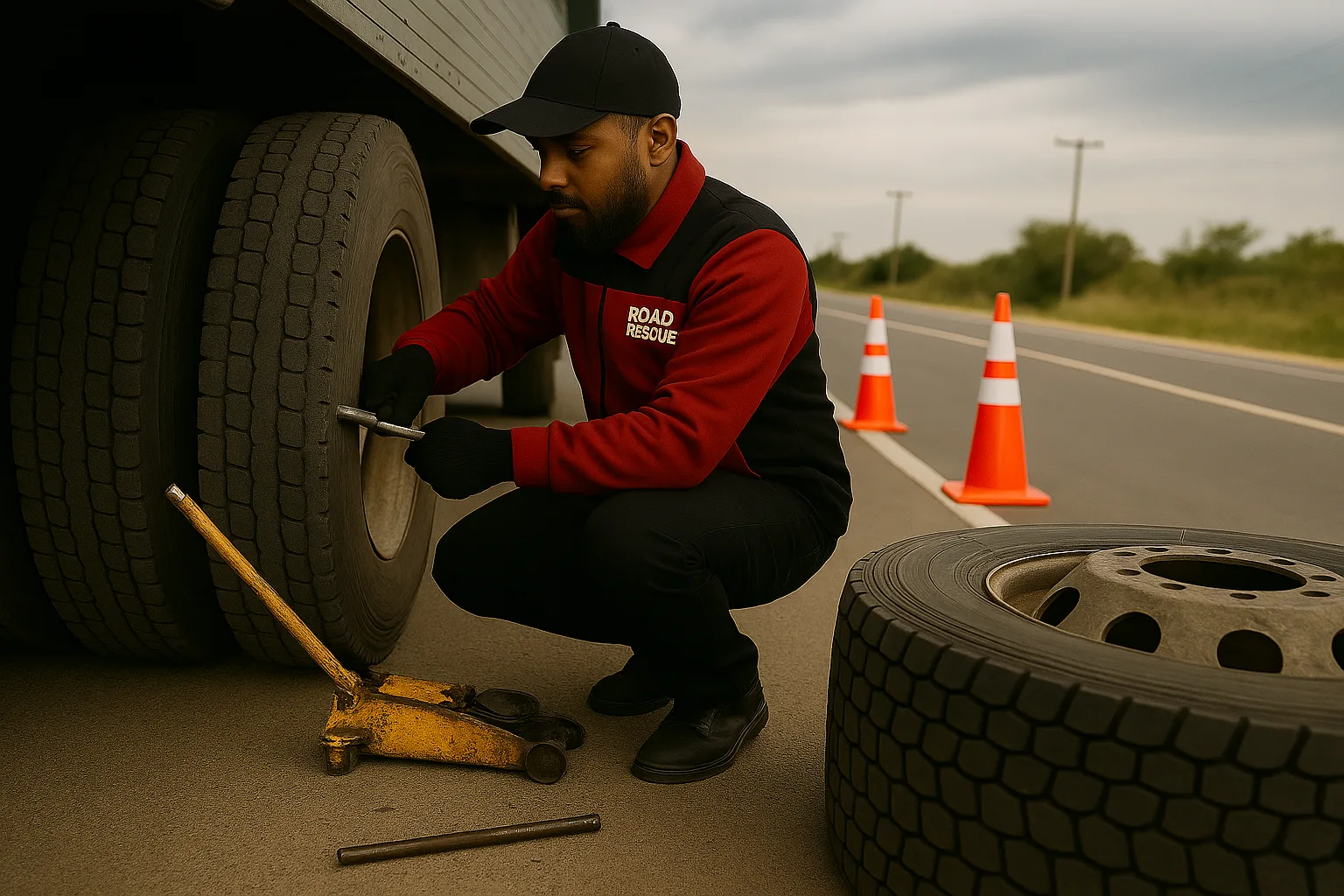
An agricultural or earthmover tire can weigh several hundred pounds and hold hundreds of pounds of liquid on top of that. A Elwood highway tire truck cannot do this work — not because the technician lacks skill, but because the handling equipment is not on it.
Boom or crane for handling, bead breaking capacity for large-diameter tires, ballast pump
Tractor, combine, sprayer, and implement tires in the field or the yard.
Heavy hydraulic handling, high-torque tooling, and section repair capability
Loader, grader, dozer, and articulated dump tires on the jobsite.
Fill and evacuation pumping with containment for chloride solution and beet juice
Any loaded tire — the fluid comes out before the repair and goes back after it.
Hydraulic press for press-on cushion tires plus solid pneumatic capability
Lift-truck fleets in warehouses, yards, and manufacturing floors.
Polyurethane fill equipment and cure handling
Scrap, demolition, and landfill machines where punctures are constant and downtime is worse.
Inflation cage, matched rim components, and the federally required servicing charts
Every multi-piece and lock-ring wheel. This is a safety requirement, not an option.
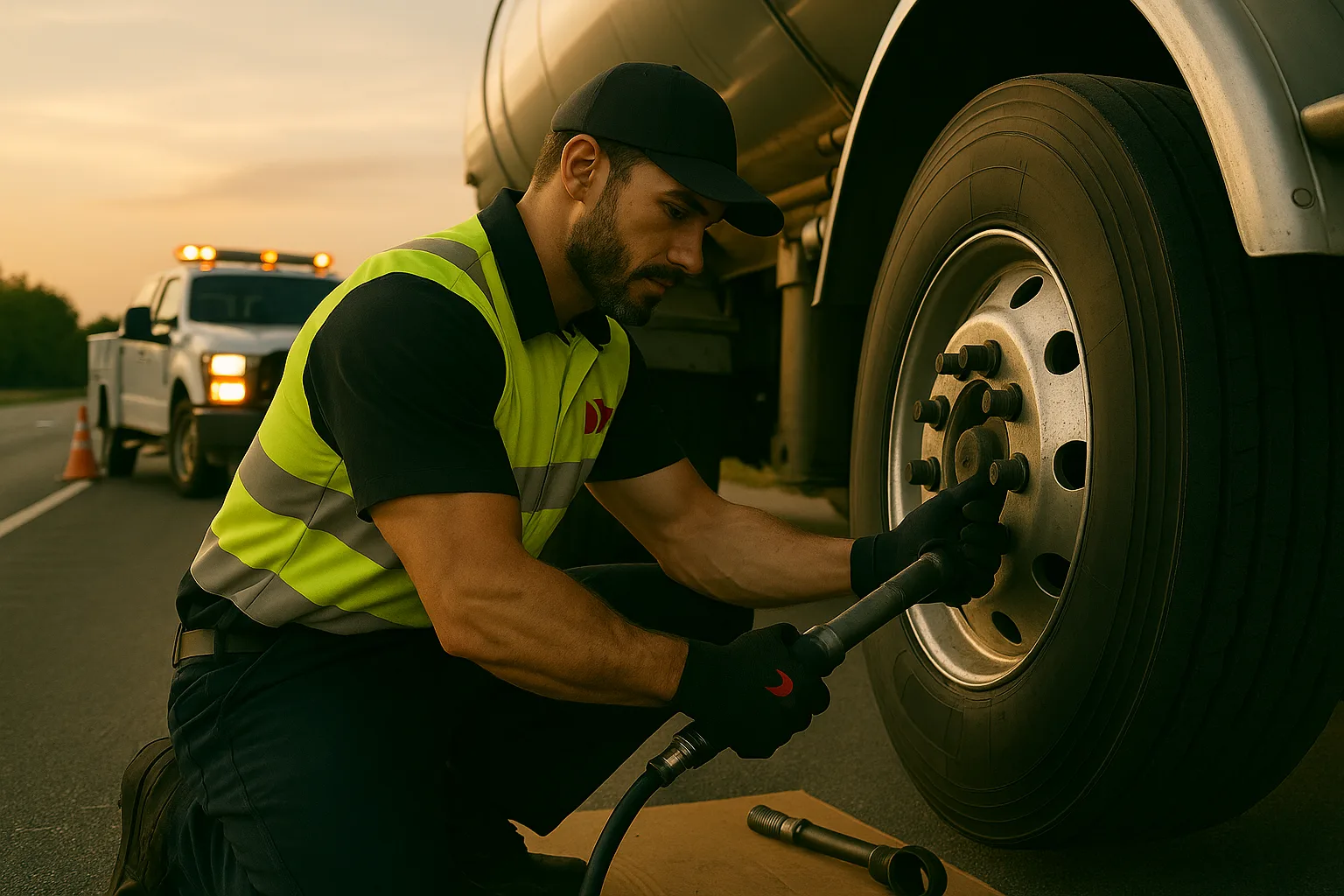
One call puts a tractor tire repair unit on the road to you anywhere in Elwood and the surrounding Will County. Tell us where you are stopped and we do the rest.
Tires on machines that mostly do not drive on roads — tractors, loaders, graders, forklifts, and yard equipment — serviced where the machine sits across Elwood. Highway truck tires are a different job on different equipment; that work lives on our mobile tire repair page.
Punctures, stubble damage, and sidewall injuries assessed for repairability rather than replaced by default. A Elwood tractor tire is a four-figure item, so the repair-versus-replace call is worth making carefully.
Most loaded ag tires carry hundreds of pounds of liquid ballast, and it comes out before any repair and goes back after. This is the step that makes a Elwood field tire job a different trade from a truck tire job.
Matching construction and load rating to the machine and the work. Increased-flexion and very-high-flexion tires carry the same load at lower pressure, which is the whole point of them on a Elwood field.
Tread designation matched to ground conditions — general agricultural, deep, wet and flooded, turf, or industrial. Fitting the wrong one to a Elwood machine costs traction, fuel, or the turf it drives on.
Dual assemblies, spacing, and row-crop width changes. Heavy, awkward work that needs handling equipment rather than muscle on any Elwood farm.
Tube replacement, tubeless conversion where the rim supports it, and sealing corroded beads. Corrosion from old calcium chloride ballast is the most common Elwood cause of a tire that will not hold air.
L-2 through L-5 traction and rock service tires on wheel loaders and related machines. Rock cuts and sidewall damage decide whether a Elwood tire is repairable, and the assessment matters more than the repair.
G-series grader tires and earthmover fitments on heavy equipment, serviced on the Elwood site rather than trucked to a shop the machine cannot easily reach.
Section repair on large off-road tires where the injury permits it — a genuine and long-established practice on casings worth far more than the repair. Frequently the right answer on a Elwood machine and frequently not offered.
Mixed-fitment machines with different front and rear requirements, plus the solid and severe-duty options that suit Elwood demolition and scrap work.
Rim inspection, component matching, and replacement of cracked or distorted wheels. On a Elwood multi-piece rim this is a safety inspection first and a tire job second.
A stopped machine on a live Elwood jobsite holds up everything around it. Response is dispatched to the site, on the ground where the machine failed.
Solid press-on tires pressed off and on with the correct equipment. This is machine work, not hand work, and it is why a Elwood forklift tire call needs a press unit rather than a tire iron.
Solid replacements for pneumatic fitments on machines working where punctures are constant — Elwood scrap yards, recycling floors, and demolition sites.
Conventional pneumatic fitments on rough-terrain and outdoor lift trucks across Elwood yards and lumber operations.
Non-marking and polyurethane tires for Elwood food, pharmaceutical, and clean-floor environments where a black tire mark is a real problem.
Press-on tires carry a wear indicator, and running past it damages the wheel and the truck rather than merely the tire. A Elwood fleet that replaces on the line spends less than one that replaces on failure.
Scheduled tire service across a Elwood lift-truck fleet, batched into one visit rather than handled one breakdown at a time.
Ballast filled, topped, or removed — beet juice, chloride solution, or plain water depending on what is in there and what the Elwood climate does to it in January.
Calcium chloride is hard on steel, and decades of it eats rims from the inside. Frequently the real reason a Elwood tire will not seal, and the tire gets blamed.
Polyurethane fill for machines where punctures are constant. It ends flats permanently and it also ends repairability, adds substantial weight, and costs real money to dispose of — a Elwood decision worth making deliberately.
Cracked, bent, or corroded wheels replaced rather than nursed. A Elwood rim failure under load is far more dangerous than a tire failure.
Multi-piece and lock-ring assemblies serviced under the federal safety procedure — deflated fully before demounting, matched components, and inflation inside a restraining device. Never on a Elwood shortcut.
Large-bore valves, water valves, extensions, and hardware suited to ballast and off-road service, which are not the parts on a Elwood highway tire truck.
Off-road tire work prices differently from highway tire work, and the tire itself is often the smaller half of it. Below is what actually moves a Elwood invoice on a machine that does not drive to you.
A large agricultural or earthmover tire needs handling equipment to move at all. Size drives labor time, the class of truck dispatched, and whether one technician can complete the job.
A loaded tire holds hundreds of pounds of liquid that must be pumped out before the repair and back in afterward, with containment. It is routinely the longest step in the job.
Off-road casings are expensive enough that repair — including section repair on large OTR tires — is frequently the right answer. Assessing repairability honestly is where the money is actually saved.
A machine in a yard on hard standing and a machine sitting in soft ground on a slope are different jobs. Terrain decides whether the work is even safe to attempt where the machine stopped.
Corroded, cracked, or mismatched rim components turn a tire job into a wheel job. Old chloride ballast is the usual cause, and it is discovered rather than predicted.
Liquid ballast, foam fill, or air are three different costs with three different consequences. Foam ends punctures permanently and also ends repairability, adds weight, and carries a real disposal cost later.
Servicing a yard of lift trucks or a run of implement tires on one visit prices very differently per unit than a single emergency call. Concentration is the lever the customer controls.
A machine stopped mid-shift on a jobsite is emergency work priced accordingly. The same tire replaced during planned downtime is the cheapest version of the job.
Off-road tire work is quoted per job after we know the tire, the fill, and where the machine is sitting. A quote given without those three is a guess, and the ballast is the part people forget.
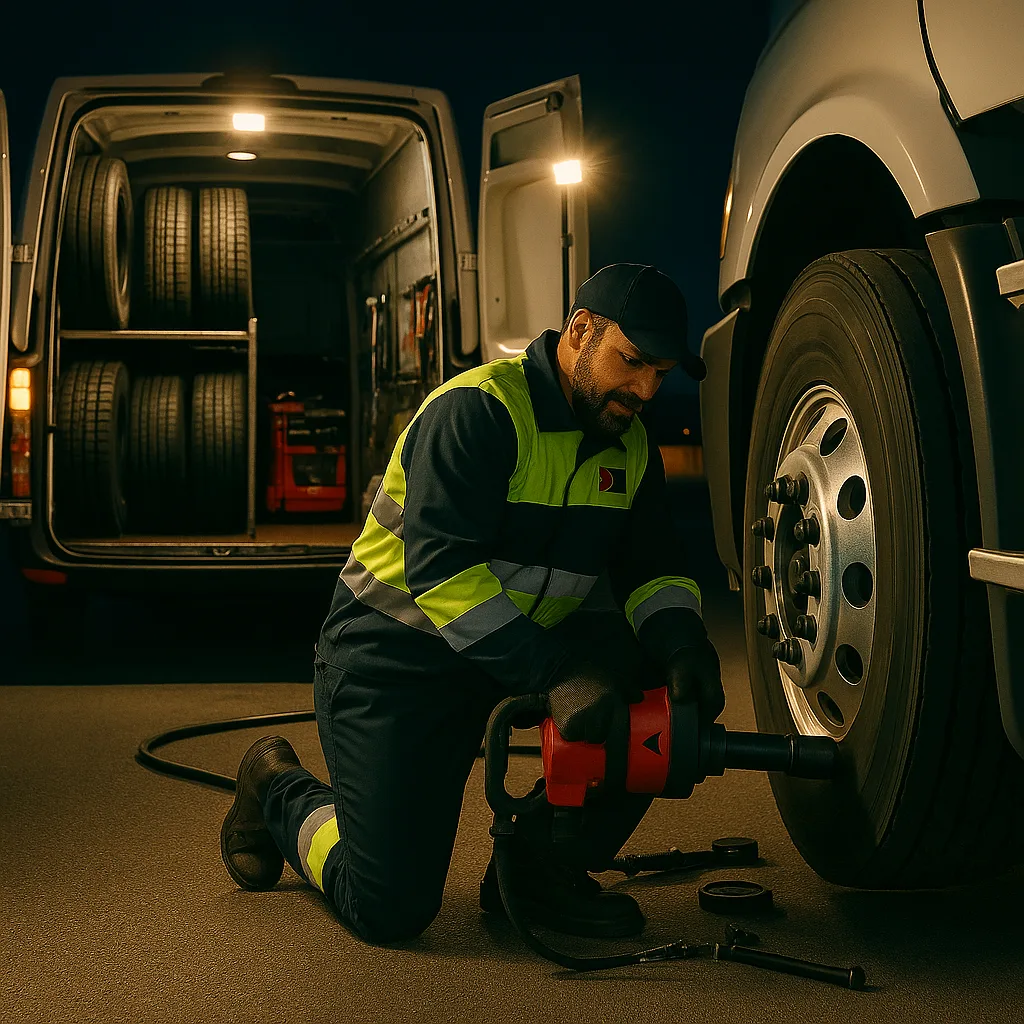
The same crews that run Elwood also cover Channahon (8 mi), Joliet (12 mi) and Minooka (6 mi), so a call from either side of Will County reaches the same desk.
Each service links to local response times, rescuer coverage, and recent dispatched jobs in this metro.
Patterns observed across recent dispatch data in this metro, by service type and corridor.
5:30 AM winter morning, minus-eight-degree ambient at Harbor Freight DC (Elwood). Loaded trailer from overnight freeze-check ready for 6 AM departure. Driver starts tractor; fuel lines gelled from sub-zero overnight cold. No engine cranking. RRN mobile fuel-system tech dispatches immediately (contacted by DC dispatch). Drains gelled fuel, flushes filter housing with heated solvent, installs new filter, delivers premium winter-grade diesel with anti-gel additive. Truck rolls by 6:15 AM, preserves national distribution schedule. DC postpones one backup tractor; no cascading delays.
Morning dock arrival, loaded tractor with time-sensitive shipment. Backup attempted; battery voltage collapses. RRN dispatches immediately with reserve battery. Mobile tech performs load-test, confirms battery failure (cold-rated battery too old for extreme cold). Swaps battery, cleans corrosion, applies terminal upgrade. Truck rolls within 18 minutes. Driver receives new battery recommendation; DC shifts load to backup unit if needed, minimal impact.
Heavy snow overnight, icy morning. Loaded tractor exiting Harbor Freight DC on County Road 48 hits unexpected ice, jackknifes. Trailer blocks warehouse gate access. RRN dual-unit recovery immediately mobilized. First unit chains tractor, second chains trailer. Coordinated extraction rights vehicles over 45 minutes. DC temporarily diverts outbound traffic to alternate staging area. No cargo damage; tractor towed to FleetPride (Chicago) for frame/suspension inspection. DC resumes normal outbound flow.
Truck departing Elwood on I-55 northbound toward Chicago distribution. Alternator bearing fails; no charging. Battery slowly discharges over 8 miles. Low-voltage warning lights; driver pulls to shoulder before losing all power. RRN mobile diagnostics arrives, confirms alternator failure. Loads battery to prevent stranding, coordinates controlled tow to FleetPride Chicago with priority bay. Load transferred to backup tractor at staging; on-time delivery preserved. RRN coordination prevents dock window loss.
County Road 48 to Harbor Freight DC congestion: multiple trucks queued for loading dock, stop-and-go over 2 miles. Transmission temperature climbs on one tractor. Driver notices delayed shifts; pulls aside before DC gate. RRN mobile tech checks transmission fluid (low) and cooler (salt-fouled). Top-off and cooler-line pressure test restore function. Truck advances into dock sequence; no rescheduling impact. Driver advised to schedule cooler flush and transmission service during maintenance window.
Trailer approaching Harbor Freight DC loading dock; air-brake pressure drops from 120 PSI to 75 PSI. Driver feels loss of brake response. Pulls aside on County Road 48 near warehouse. RRN air-brake tech dispatched; pressure-tests system, identifies slow leak in trailer supply line. Replaces damaged hose coupling with new assembly, recharges to spec. Pressure holds at 120 PSI. Truck resumes dock entry within 22 minutes; no load rescheduling.
Off-road tire servicing is governed by workplace safety law rather than by the highway rules that cover truck tires. The distinction matters in Illinois: there is no federal tread-depth minimum on a machine that never enters the roadway, and there is a very specific federal procedure for the wheel it is mounted on.
Federal law sets a specific procedure for servicing multi-piece and single-piece rim wheels on trucks, tractors, trailers, buses, and off-road machines. It requires a trained employee, the manufacturer's charts available in the service area, correct and matched rim components, and a restraining device for inflation. It expressly does not cover automobile or light-truck tires — this rule exists because these assemblies store enough energy to kill.
The tire must be fully deflated, with the valve core removed, before any demounting begins — including on a dual assembly where both tires are deflated. Attempting to break a bead on a pressurized large rim wheel is one of the most dangerous shortcuts in the trade, and it is the one the regulation exists to prevent.
Inflation is performed inside a restraining device or cage, with the technician standing clear of the trajectory — the path a component takes if the assembly separates. No one stands over the wheel, and no one strikes an inflated assembly with a hammer. These are not shop preferences, they are written requirements.
Rim bases, rings, and lock rings must be matched by manufacturer, size, and type. Mixed components can appear to assemble correctly and then separate under pressure. Any cracked, bent, badly corroded, or unidentifiable component is scrapped rather than reused.
Forklift tire condition falls under the powered industrial truck standard, which requires that a truck found to be in unsafe condition be removed from service. Press-on tires carry a wear indicator, and running past it transfers load into the wheel and the truck rather than the tire.
The federal tread-depth minimums and out-of-service criteria that govern truck tires apply to commercial vehicles on the highway, not to a loader working a pit. But the moment equipment travels a public road under its own power or on a trailer, road-legal requirements attach to that movement, and tire condition becomes part of it.
Calcium chloride solution is corrosive and beet juice is not, but neither is simply poured out on the ground. Evacuated ballast is contained and disposed of appropriately, and foam-filled tires carry a genuine end-of-life disposal cost that should be part of the decision to foam fill in the first place.
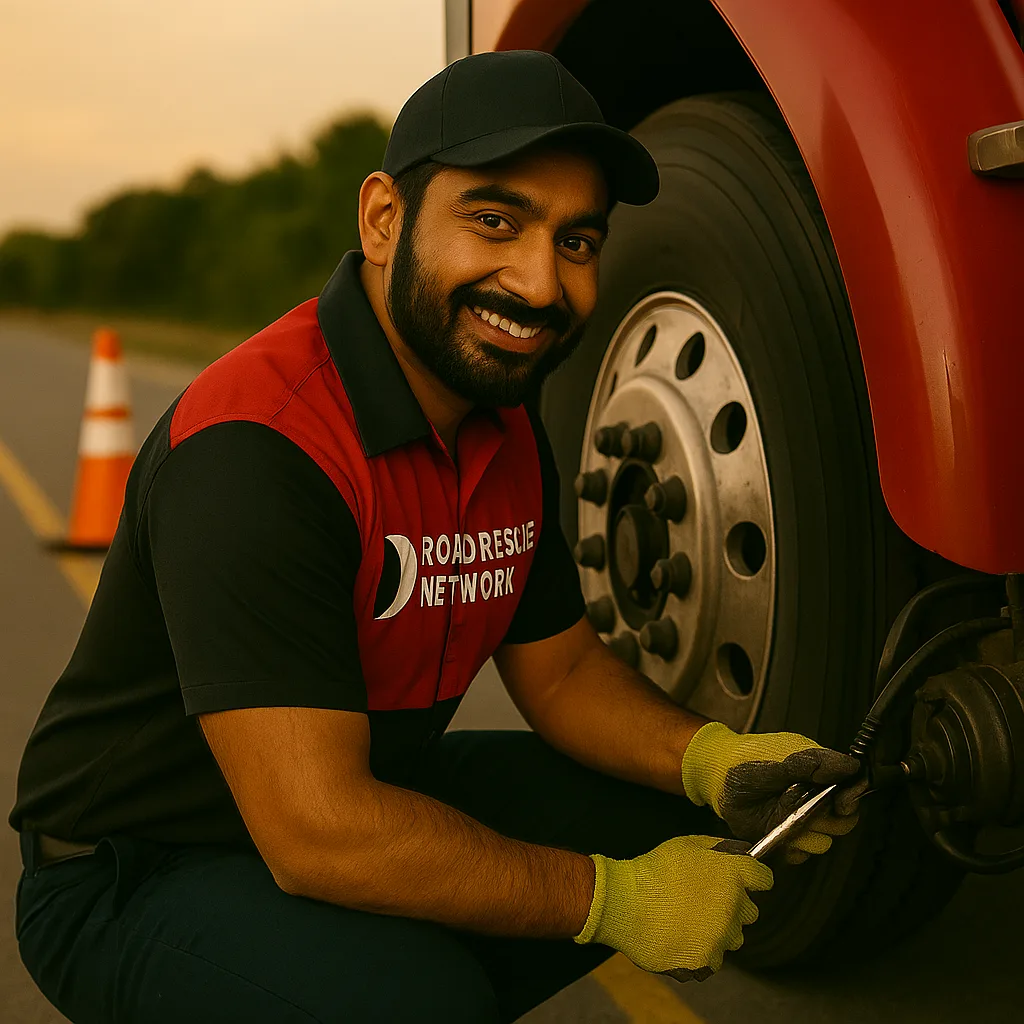
You get a real time before anyone rolls, and the price before the work starts. No motor club runaround and no waiting on a callback.
Harbor Freight DC in Elwood drives regional and national distribution logistics. The distribution center operates 24/7, routing tools, equipment, and merchandise to retail stores across the Midwest and beyond. A single tractor breakdown at the loading dock or on access roads can back up 5–10 trailers scheduled for departure, multiplying delays nationally. Peak outbound windows (early morning, 6–8 AM, and afternoon, 2–4 PM) see 40–50 trucks staging for dispatch. Winter weather during peak windows can snarl the entire operation; RRN priority dispatch during sub-zero conditions is critical to maintaining distribution schedules.
Elwood is a village in rural Will County, Illinois, United States, approximately 45 miles southwest of Chicago. The population was 2,229 at the 2020 United States census, down from 2,279 in 2010.
Elwood is a small village of 2,229 residents 45 miles southwest of Chicago, but punches far above its weight as a regional distribution hub. Harbor Freight Tools Distribution Center (3401 S Brandon Rd) anchors the area as the primary employer, staging trucks for nationwide retail distribution. While Elwood itself has limited highway presence on state mapping, the village is adjacent to I-55 access and benefits from proximity to Joliet’s I-55/I-80 interchange zone. Local roads (Township Roads, County Routes) route trucks between the distribution center and I-55 ramps, creating a consistent stream of relay traffic toward Chicago’s warehouse district and regional markets. Breakdowns at or near Harbor Freight DC create urgent scheduling impacts; a disabled trailer can delay dozens of outbound shipments across the nation.
Winter weather in Elwood follows the Chicago metropolitan pattern: December through March brings ice storms, heavy snow, and sub-zero cold. The village’s rural setting provides less urban heat-island insulation; temperatures can drop 3–5 degrees lower than downtown Chicago on clear nights. Moisture from farm ponds and small waterways accelerates frost and black-ice formation on local road surfaces near distribution facilities. Salt application on access roads is lighter than urban zones; rural roads may become icy and treacherous. Battery failures and fuel gelling are more common here due to colder ambient; trucks staging overnight in frozen conditions face mechanical challenges.
Road Rescue Network serves Elwood with priority focus on Harbor Freight DC logistics and regional warehouse operations. We maintain 24/7 mobile dispatch for local roads connecting Elwood to I-55 and Joliet corridors. Vendor partnerships include River Valley Truck Parts (Kankakee), FleetPride Chicago, and independent shops trained in rapid-response warehouse emergencies. Winter-specialty services include fuel additives, battery exchange, and roadside diagnostics calibrated for sub-zero conditions. We coordinate directly with Harbor Freight logistics to preserve dock scheduling and minimize cargo staging delays during breakdowns. Our network extends into Channahon, Minooka, and the greater Will County warehouse cluster.
Not a general tire shop, in most cases, and that is the honest starting point. A tractor tire is large, heavy, usually loaded with several hundred pounds of liquid ballast, and frequently mounted on a wheel that requires a specific federal servicing procedure. Doing the work needs a service truck with handling equipment — a boom or crane — bead-breaking capacity for the diameter, a ballast pump with containment, and a restraining device for inflation. Your options in Elwood are an agricultural tire dealer, an equipment dealer's service department, or a mobile off-road tire service that comes to the machine. The last one is usually what people actually want, because a tractor with a flat is not driving anywhere and hauling it is its own expense. What you should avoid is a highway truck tire service treating it as a big truck tire. The skill transfers; the equipment does not, and the ballast alone will stop the job.
Frequently yes, and given what a large agricultural tire costs, it is worth asking before accepting a replacement. Tread-area punctures are commonly repairable, and larger injuries can often be handled with a section repair — a long-established practice on big casings where the damage is assessed, the injury prepared, and a reinforced repair applied. What is generally not repairable is significant sidewall damage, since the sidewall flexes constantly and carries the load; a separation or a break in the casing cords; damage from long running flat, which destroys the inner liner even when the outside looks fine; and severe weather checking or rot in an old tire. Two practical points. First, a loaded tire has to have its ballast pumped out before any repair and refilled afterward, which is a real part of the job. Second, if the tire will not hold air after a competent repair, suspect the rim — decades of chloride ballast corrode wheels from the inside, and the tire often takes the blame for a rim problem.
The tire itself varies enormously — a small implement tire and a large rear radial on a high-horsepower tractor are different orders of magnitude — so the useful answer is what drives the total beyond the tire. Size and weight decide the handling equipment and the labor time. Ballast is the big one people forget: several hundred pounds of fluid pumped out, contained, and refilled adds real time to every loaded tire. Construction matters, because radial, increased-flexion, and very-high-flexion tires cost more than bias and generally return it in traction, fuel, and soil compaction. Where the machine is sitting affects access and safety. And the rim decides whether this stays a tire job — corroded or cracked wheels found during the work turn it into a wheel job. Before replacing, get a genuine repairability assessment in Elwood, including whether a section repair would hold. On a casing worth what these are worth, that conversation is worth having every time.
Yes, and it is genuinely different work again from either farm or highway tires. Lift trucks run press-on cushion tires, solid pneumatics, conventional pneumatics, or non-marking polyurethane depending on the machine and the floor, and press-on tires are pressed off and on with hydraulic equipment rather than mounted by hand — which is why this needs a press unit on site rather than a tire iron. The most useful thing to know is that press-on tires carry a wear indicator, sometimes called a safety line, and running past it stops being a tire problem: load transfers into the wheel and the truck, and the damage costs more than the tire did. Federal workplace rules also require that a powered industrial truck found in unsafe condition be taken out of service. For a Elwood warehouse or yard running several lift trucks, the cheapest approach is scheduled service across the fleet on one visit rather than a call per breakdown.
They solve different problems and people frequently buy the wrong one. Liquid ballast — beet juice, chloride solution, or water — adds weight low in the tire for traction and stability, mostly on agricultural machines. It is reversible, it does not stop punctures, and the choice of fluid matters: chloride solution is corrosive and will eat rims over decades, beet juice is not, and plain water freezes. Foam fill is polyurethane pumped in to replace air entirely. It permanently ends flats, which is why it belongs on scrap, demolition, landfill, and recycling machines where punctures are continuous and downtime is expensive. What it costs you is real: the tire becomes unrepairable, gains substantial weight that the machine has to carry, rides harder, and carries a genuine disposal cost at end of life. The rule of thumb is that foam fill is worth it where you are pulling punctures constantly and the machine works slowly on a fixed site, and it is a poor trade on anything that travels or where flats are occasional.
Yes, under the federal procedure that exists specifically for these assemblies — and the reason the procedure exists is worth stating plainly. A multi-piece rim wheel stores enough energy that a component separating during inflation can be fatal. Federal workplace rules require a trained technician, the manufacturer's servicing charts available, rim components correctly matched by manufacturer, size, and type, complete deflation with the valve core removed before any demounting, inflation inside a restraining device, and nobody standing in the trajectory. Cracked, bent, badly corroded, or unidentifiable components are scrapped rather than reused, and nothing gets struck with a hammer while it holds pressure. That is how we do it, and it is the honest reason a job like this takes longer than you might expect. If anyone offers to service a lock-ring wheel faster by skipping the cage or breaking a bead on a pressurized assembly, that is not a better price — it is a different risk, and it is being taken on your site.
Call RRN immediately and mention Harbor Freight DC Elwood. We coordinate directly with DC logistics and warehouse operations. For mobile-repairable issues (fuel, battery, air-brake diagnostics), we typically fix on-site within 20–30 minutes. For major work (transmission, engine), we arrange fast-track towing with backup tractor coordination so your load continues to national distribution. DC appreciates early notification; we can often preserve scheduling by offloading cargo to standby unit.
Yes. RRN maintains winter-grade diesel (treated with cold-flow enhancer) in mobile delivery tankers November through March. If you’re at Harbor Freight DC or anywhere in Elwood and fuel lines are gelling, call immediately. Average delivery response is 22 minutes. We can also deliver to local truck stops (Pilot Channahon, Minooka) for pre-fueling before winter hauls.
County Road 48 is rural with lighter salt maintenance than urban roads. Ice forms quickly during freeze events. Early morning (5–8 AM) is most treacherous due to overnight frost and reduced traffic to break ice. If you’re approaching the DC during freeze warnings, add 15–20 minutes to your ETA. RRN monitors County Road 48 conditions and provides emergency recovery if you jackknife or slide. Report hazards via app so we can alert other DC-bound trucks.
Absolutely. Harbor Freight DC typically has sub-zero startup challenges during January–February extremes. RRN pre-positions heated-battery reserves at staging areas near Elwood. Call with battery failure symptoms; we’ll deploy mobile tech with replacement within 18–20 minutes. Installed battery is tested under load before departure. Driver receives recommendation for battery upgrade if rated for less than 1000 CCA for your engine.
For mobile-repairable issues: 20–30 minutes (minimal impact). For major work: 2–4 hours (DC coordinates backup tractor, your load continues). RRN coordinates with DC dispatch to minimize rescheduling by offloading to standby unit or towing to priority-bay shop. Worst-case (multi-hour major repair): 6–8 hour delay, but RRN works to preserve your place in national distribution queues.
Elwood itself has no dedicated truck stop, but nearby: Pilot Travel Center (Channahon, 11 miles), Love’s (Channahon, 15 miles). Pilot Minooka (301 Ridge Rd) is 8 miles away. RRN can arrange overnight warehouse staging at Harbor Freight or nearby facilities if your load is compatible. For extended repairs, we coordinate with FleetPride Chicago or River Valley Truck Parts (Kankakee) with bay overnight staging.
Elwood doesn’t have a dedicated DOT station, but RRN coordinates inspections at Will County authorized facilities (Joliet area, 12 miles). Mobile pre-trip inspections for brake, lighting, tire, hazmat compliance average 24 minutes at Harbor Freight DC or roadside. Schedule in advance through app. For pre-departure checks at DC, we can often coordinate inspection at loading dock area.
Peak outbound (6–8 AM, 2–4 PM) creates stop-and-go queuing on County Road 48. Preventive: (1) Check transmission fluid monthly. (2) Monitor temperature gauge during dock staging. (3) Shift to neutral during extended stops. (4) Schedule cooler flush annually to remove salt/debris. If temperature climbs during staging, exit queue, cool 10 minutes, re-enter. RRN mobile diagnostics can check cooler condition roadside (28 min).
Call RRN immediately (5–30-min response). Mobile fuel-system tech will drain gelled fuel, flush filter, deliver winter-grade diesel with anti-gel. Truck typically rolls within 20–30 minutes. For future cold seasons, pre-treat all fuel loads with approved cold-flow additive and consider block heater installation. RRN can refer you to equipment vendors for engine-block heater setup.
Yes. Mobile air-brake service available on all local roads (County Road 48, I-55 access) and I-55 corridor from Elwood. Average response 30 minutes. Common issues: pressure loss from cold-weather moisture icing in compressor discharge, trailer supply-line leaks (salt corrosion), valve stiction. We carry replacement valves, hose couplings, and desiccant cartridges. Pressure-test confirms integrity before you roll.
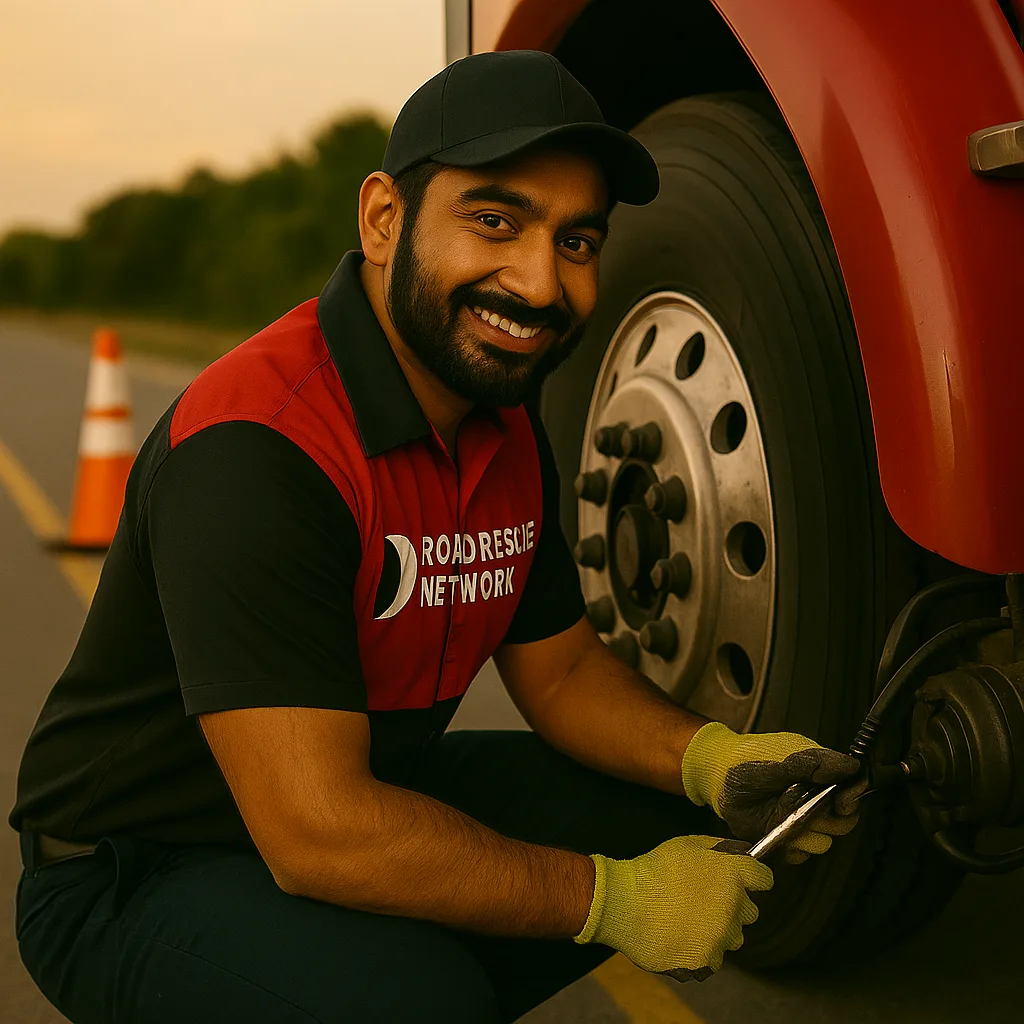
Elwood runs about 2,229 people and sits in Will County, inside the Elwood Warehouse District (Chicago Metropolitan Extended). We take the call, find the closest crew that actually does this work, and tell you what it costs before anyone turns a wheel.
Coverage in surrounding cities and metros across the same network of verified rescuers.
The same verified network of providers, dispatched 24/7 across every major Illinois metro and freight corridor.
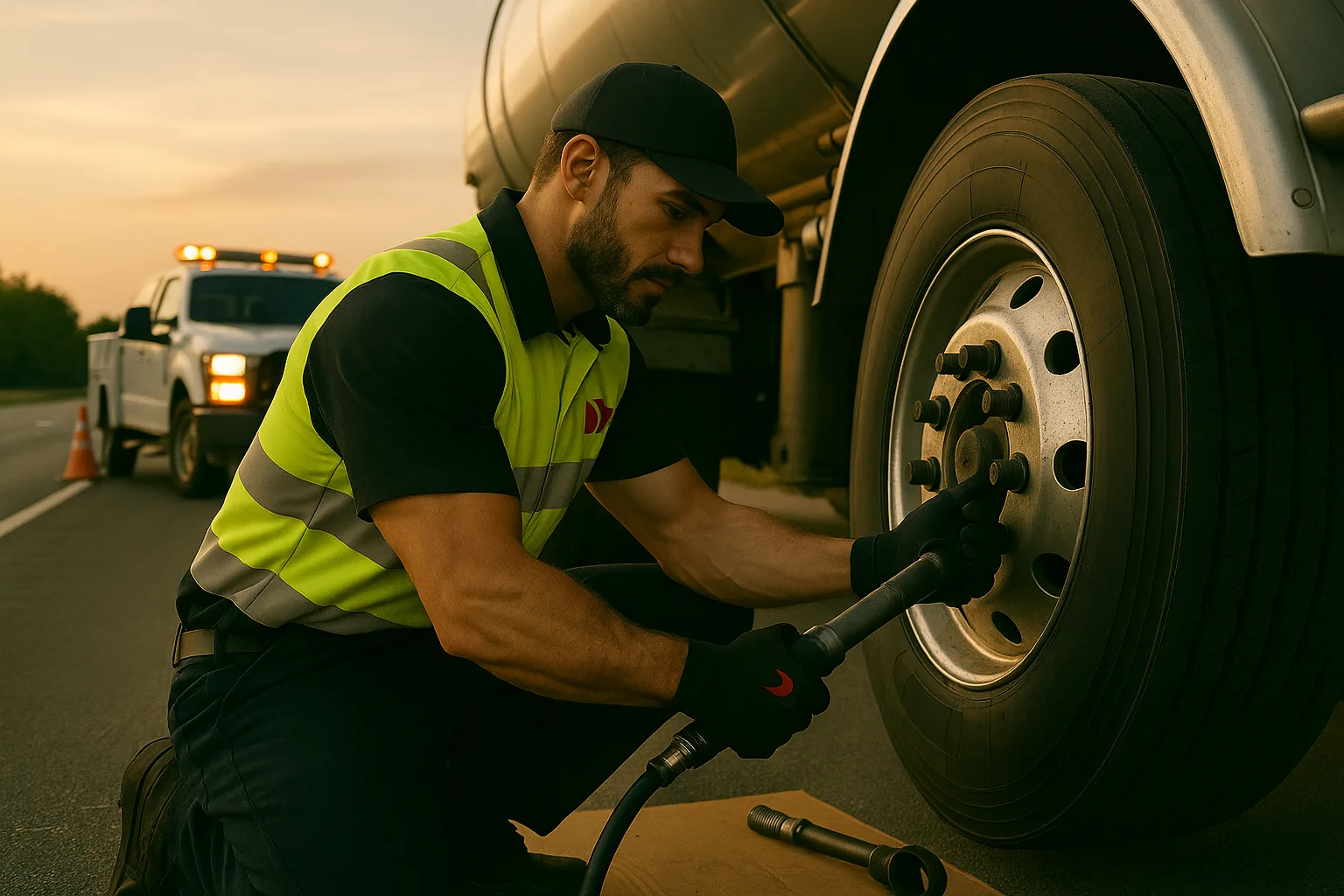
Whether the truck is sitting in Elwood or out toward Minooka, it is the same phone number and the same crews. One call, day or night.
Road Rescue Network is actively recruiting verified tractor tire repair providers in the Elwood metro. Heavy traffic, real fleet leads, no auction race-to-the-bottom, straight rescuer-to-customer dispatch with confirmed pricing.
We send Elwood tractor tire repair calls directly to verified rescuers in your service radius. Apply once. Insurance & DOT verified. Live dispatch, fleet accounts, transparent pricing, no motor-club shave-down.
Deep-dive guide on choosing the right provider, common pitfalls, and what to expect on a service call.
OpenOpen positions at our network rescuers, full-time, part-time, and 1099 contract.
OpenOn-site photos from recent calls, see the work, not just the marketing.
OpenNetwork technicians carry diagnostic equipment, OEM-spec tooling, and common-failure parts for every major tractor tire repair brand on the road. Out-of-stock specifics order in within 24 hours.
Service trucks dispatch routinely to these locations across the metro freight corridors.


Local parts houses and diesel suppliers used by network mechanics for time-critical roadside repairs.
Major shippers, distribution centers, and industrial freight nodes generating outbound and inbound truck volume.
Three steps from the call to a cleared scene. Same flow whether you call from a fleet desk or the shoulder of an interstate.
Make and model, the size off the sidewall, and whether the tire is loaded with fluid. Those three decide which Elwood truck is dispatched, and the fill is the one people forget to mention.
Yard, field, jobsite, or warehouse floor — and what the ground is like. A Elwood machine on a slope or in soft ground changes whether the work can be done safely where it stopped.
Off-road casings are expensive enough that repair, including section repair on large tires, is often the right call. You get an honest Elwood assessment of repairability rather than a default sale.
Network rescuers accept all major credit cards, fleet cards, and consumer payment apps. Confirmed at dispatch.