01
Mobile PM service truck
Bulk oil, filters, lubricants, air and electrical tooling, and lighting for overnight work
Scheduled A and B services performed at your yard on your parking cycle.
Running trucks out of Elwood? We service them at your yard on your parking cycle and keep the records properly — so a roadside breakdown and a compliance audit both stop being surprises. The same trucks cover Channahon, Joliet, and Minooka, so a call from outside town reaches the same people.
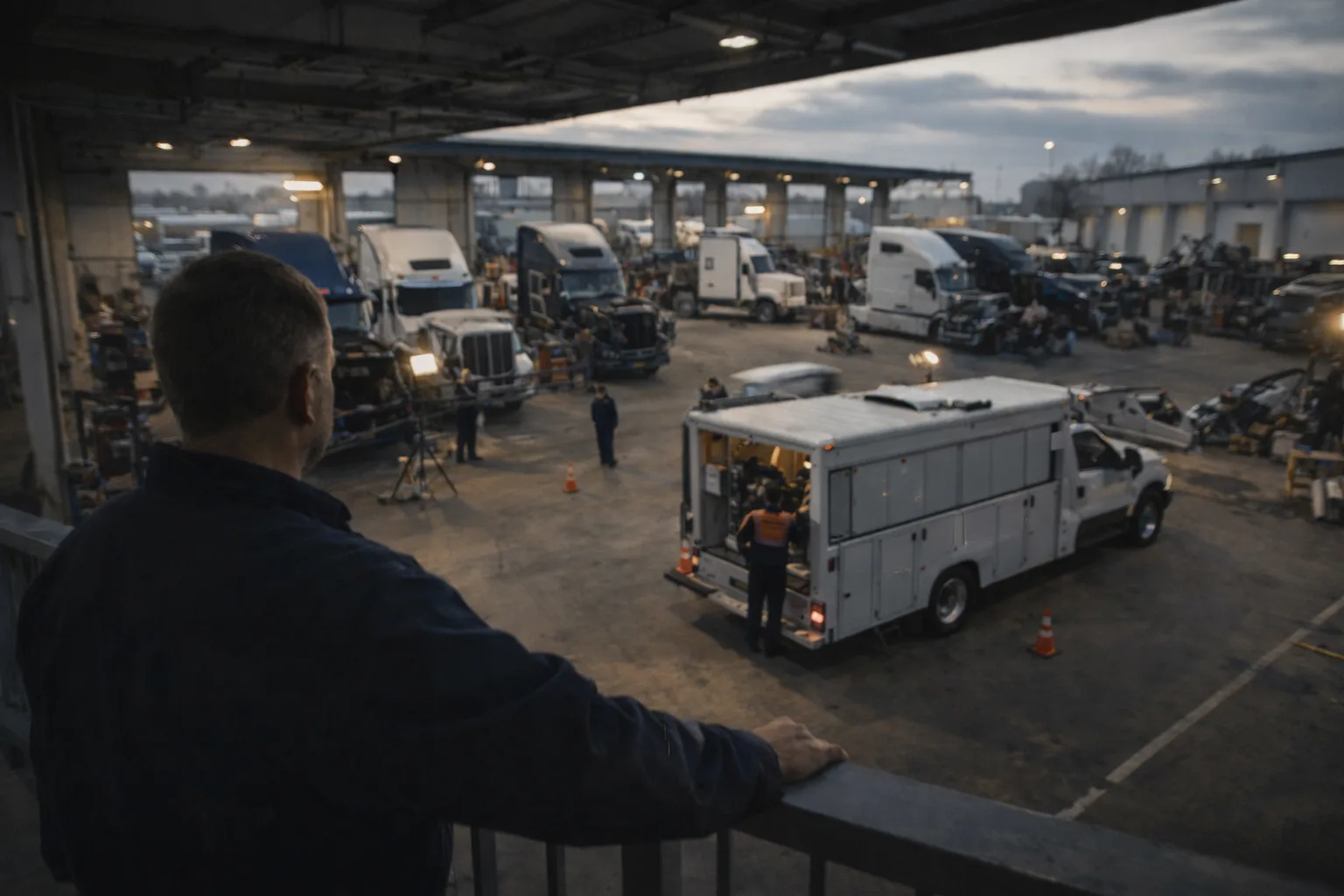
Fleet maintenance is delivered by service trucks and technicians rather than by a single class of equipment. What matters for a Elwood program is whether the unit that arrives can complete the service on your lot instead of scheduling a second visit.
Bulk oil, filters, lubricants, air and electrical tooling, and lighting for overnight work
Scheduled A and B services performed at your yard on your parking cycle.
Bulk fluid delivery with metering and used-oil recovery
Multi-unit service days where handling drums per truck would be the bottleneck.
Manufacturer-level ECM software for engine, chassis, aftertreatment, and ABS
PM services on late-model equipment where a fault code needs reading, not guessing.
Air system tooling, drum and rotor service capability, qualified brake inspector on board
B and C services, annual inspections, and any brake defect certification.
Commercial tire changing, balancing, torque, and casing evaluation
Tire program work batched into a PM day rather than run as separate visits.
Qualified inspector, inspection documentation, and decal issuance
The 396.17 annual, scheduled ahead of expiry instead of after a roadside stop finds it.
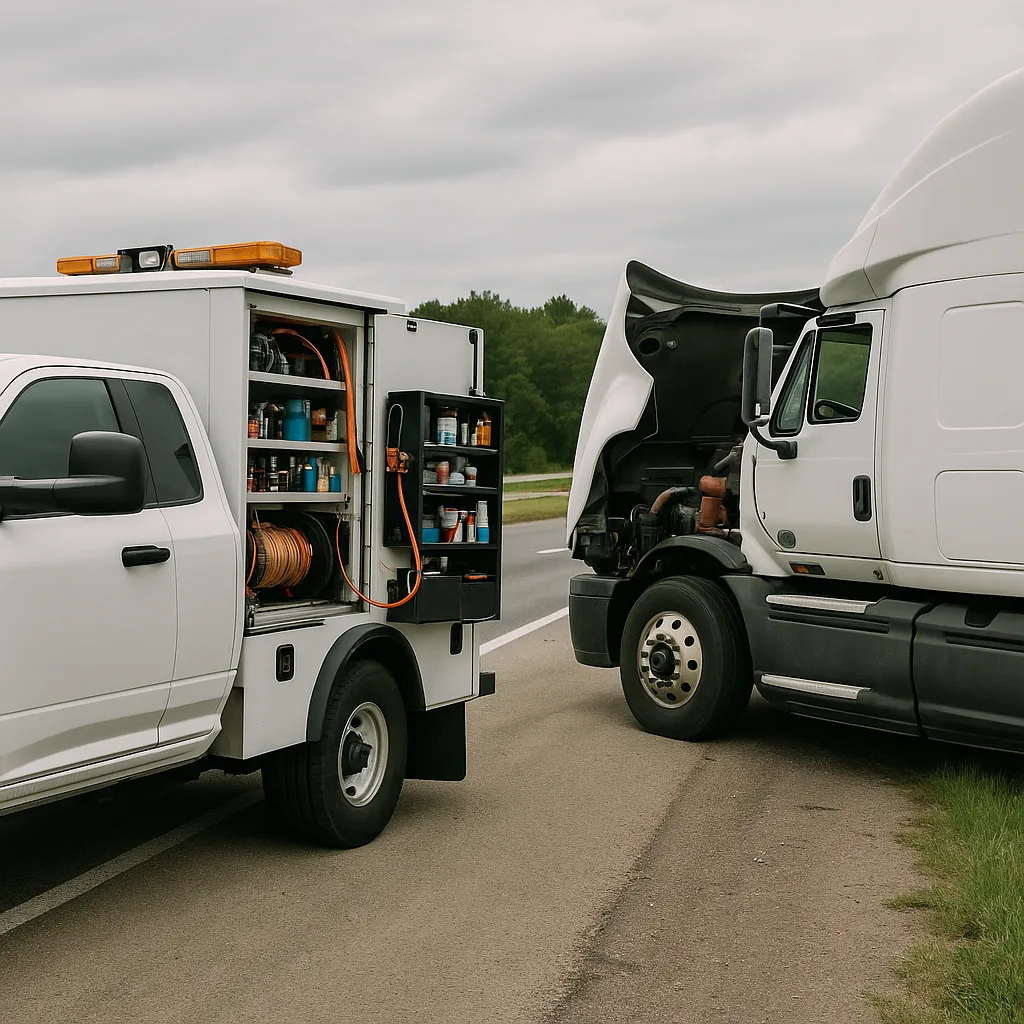
One call puts a fleet maintenance unit on the road to you anywhere in Elwood and the surrounding Will County. Tell us where you are stopped and we do the rest.
A scheduled program run against intervals and records, not a phone number you call after something breaks. The point of a Elwood PM contract is that the roadside call never happens — and that when a DOT officer asks for the file, it exists.
The short-interval service — lube, oil and filters, fluid levels, tire pressures and tread, lights, and a walkaround. Most Elwood fleets run this every 10,000 to 25,000 miles depending on duty cycle, and it is where developing faults get caught cheaply.
Everything in the A service plus brake measurement, slack adjuster travel, air system checks, driveline inspection, and steering and suspension. The service that keeps a Elwood truck out of the out-of-service category, since brakes drive more OOS violations than any other system.
Coolant and DEF quality testing, differential and transmission service, air dryer cartridge, fuel filters, and the deeper inspection items. Timed to the manufacturer's schedule rather than convenience, because a skipped Elwood C service shows up as a failure two intervals later.
The 49 CFR 396.17 annual inspection, performed by a qualified inspector and documented on the vehicle. Every commercial vehicle in your Elwood fleet needs one every twelve months, and the decal or the paperwork must be available on demand.
Rotation, matching, pressure discipline, tread depth tracking, and pull-point decisions made before a casing is scrapped. Tires are usually the second-largest maintenance line in a Elwood fleet after fuel-related work, and most of that spend is controllable.
Pre-winter and pre-summer passes — batteries and charging under load, coolant protection, air dryer and moisture, block heaters, and DEF handling. In Elwood the first hard freeze produces a cluster of failures that a September battery test would have prevented.
Driver vehicle inspection reports collected, defects repaired or certified as not needing repair, and the certification signed before the vehicle goes back out. A Elwood DVIR with an open defect and no repair record is a violation whether or not the truck was safe.
A record per vehicle identifying the unit, listing every inspection, repair, and service performed with dates and mileage. Federal rules require these be kept while the vehicle is under your control and for six months after — the file, not the memory, is what gets audited in Elwood.
Brake work performed and documented by someone meeting the federal brake inspector qualification standard. This is one of the most commonly missed requirements in a Elwood audit, because the work was done correctly by someone whose qualification was never recorded.
Watching the roadside inspection violations that feed your maintenance score, and fixing the pattern rather than the ticket. A Elwood carrier with a rising Vehicle Maintenance BASIC gets inspected more often, which produces more violations — the loop closes on itself.
A truck placed out of service at a Elwood scale or roadside needs repair before it moves, documentation of that repair, and the violation certified and returned. Handling this badly turns a one-truck problem into an audit finding.
Pulling the maintenance side of a compliance review into one package — annual inspections, DVIRs, repair orders, inspector qualifications. The Elwood fleets that fail this part rarely failed the maintenance; they failed the paperwork that proves it.
Maintenance cost per mile by unit, so the truck that is quietly consuming the budget becomes visible. Most Elwood fleets can name their fuel cost per mile instantly and cannot name their maintenance cost per mile at all.
The point where accumulated repair spend on a Elwood unit passes what a replacement would cost to run. Making this call on data rather than on the last invoice is where a fleet program pays for itself.
Tracking hours out of service and cause, separating scheduled downtime from breakdown downtime. A Elwood fleet with rising unscheduled downtime has a PM interval problem, not a luck problem.
Catching work that belongs to a manufacturer warranty or an open recall before you pay for it. Missed warranty claims are one of the few pure-refund line items in a Elwood maintenance budget.
Common filters, pads, lamps, and fluids across the Elwood fleet so that stocking is possible and a roadside repair does not wait on a part nobody carries.
Every unscheduled Elwood road call reviewed against the PM record — was the interval wrong, was the item on the checklist, or did somebody sign for an inspection that did not happen. This is the loop that makes a program improve instead of merely repeat.
Technicians and a service truck to your Elwood lot, working units while they sit. For fleets that park overnight, this converts maintenance downtime into hours the trucks were not earning anyway.
PM scheduled against your dispatch calendar rather than shop hours. A Elwood truck serviced Saturday is a truck that never missed a load.
Units serviced where they actually sit — a terminal, a customer yard, a truck stop on the lane — for fleets whose trucks rarely come home to Elwood.
Alignments, major driveline, frame and body work, and anything needing a lift go to a shop. A Elwood program that pretends everything is mobile produces bad work at the roadside.
When something does break, the Elwood response is by the operator who holds your maintenance file and knows the unit, not a stranger reading a VIN over the phone.
Tractors, trailers, straight trucks, and light service vehicles under one Elwood schedule. Most fleets are mixed, and splitting them across vendors is how intervals get missed.
Fleet maintenance is not priced like a road call. A Elwood program is quoted per unit against a written scope — which services, at which intervals, on which equipment — so the honest answer to "what does it cost" is a description of the structure and the variables, not a single number. Below is what actually moves a quote.
Per-unit cost falls as unit count rises, because a service day amortizes travel across every truck on the lot. A mixed fleet of tractors, trailers, and light vehicles prices per class rather than as one blended rate.
An A-service-only program and a full A/B/C program with annual inspections are different products. Shortening intervals raises the program cost and usually lowers total maintenance cost — that trade is the whole decision.
Service at your yard on your parking cycle prices differently than service scattered across locations or performed on-route. Concentration is the single biggest lever a fleet controls.
Overnight and weekend windows carry a premium and frequently pay for themselves, because a truck serviced outside dispatch hours never left the revenue schedule.
A five-year-old vocational truck in stop-and-go service consumes more PM than a two-year-old highway tractor at the same mileage. Duty cycle predicts cost better than odometer reading.
OEM versus quality aftermarket, and extended-drain versus conventional oil, change both the invoice and the interval. The cheaper filter on a longer interval is sometimes the more expensive choice.
Annual federal inspections, DVIR handling, brake inspector documentation, and maintenance file assembly can be inside the program or billed as performed. Inside is usually cheaper and always more complete.
Programs that include emergency response price higher per unit and lower per incident. Fleets with thin spare capacity generally find the attached coverage cheaper than paying road calls at retail.
Programs are quoted per unit against a written scope. We do not publish a per-truck rate because a rate quoted without the scope beside it is not comparable to anything — including our competitors' numbers.

The same crews that run Elwood also cover Channahon (8 mi), Joliet (12 mi) and Minooka (6 mi), so a call from either side of Will County reaches the same desk.
Each service links to local response times, rescuer coverage, and recent dispatched jobs in this metro.
Patterns observed across recent dispatch data in this metro, by service type and corridor.
5:30 AM winter morning, minus-eight-degree ambient at Harbor Freight DC (Elwood). Loaded trailer from overnight freeze-check ready for 6 AM departure. Driver starts tractor; fuel lines gelled from sub-zero overnight cold. No engine cranking. RRN mobile fuel-system tech dispatches immediately (contacted by DC dispatch). Drains gelled fuel, flushes filter housing with heated solvent, installs new filter, delivers premium winter-grade diesel with anti-gel additive. Truck rolls by 6:15 AM, preserves national distribution schedule. DC postpones one backup tractor; no cascading delays.
Morning dock arrival, loaded tractor with time-sensitive shipment. Backup attempted; battery voltage collapses. RRN dispatches immediately with reserve battery. Mobile tech performs load-test, confirms battery failure (cold-rated battery too old for extreme cold). Swaps battery, cleans corrosion, applies terminal upgrade. Truck rolls within 18 minutes. Driver receives new battery recommendation; DC shifts load to backup unit if needed, minimal impact.
Heavy snow overnight, icy morning. Loaded tractor exiting Harbor Freight DC on County Road 48 hits unexpected ice, jackknifes. Trailer blocks warehouse gate access. RRN dual-unit recovery immediately mobilized. First unit chains tractor, second chains trailer. Coordinated extraction rights vehicles over 45 minutes. DC temporarily diverts outbound traffic to alternate staging area. No cargo damage; tractor towed to FleetPride (Chicago) for frame/suspension inspection. DC resumes normal outbound flow.
Truck departing Elwood on I-55 northbound toward Chicago distribution. Alternator bearing fails; no charging. Battery slowly discharges over 8 miles. Low-voltage warning lights; driver pulls to shoulder before losing all power. RRN mobile diagnostics arrives, confirms alternator failure. Loads battery to prevent stranding, coordinates controlled tow to FleetPride Chicago with priority bay. Load transferred to backup tractor at staging; on-time delivery preserved. RRN coordination prevents dock window loss.
County Road 48 to Harbor Freight DC congestion: multiple trucks queued for loading dock, stop-and-go over 2 miles. Transmission temperature climbs on one tractor. Driver notices delayed shifts; pulls aside before DC gate. RRN mobile tech checks transmission fluid (low) and cooler (salt-fouled). Top-off and cooler-line pressure test restore function. Truck advances into dock sequence; no rescheduling impact. Driver advised to schedule cooler flush and transmission service during maintenance window.
Trailer approaching Harbor Freight DC loading dock; air-brake pressure drops from 120 PSI to 75 PSI. Driver feels loss of brake response. Pulls aside on County Road 48 near warehouse. RRN air-brake tech dispatched; pressure-tests system, identifies slow leak in trailer supply line. Replaces damaged hose coupling with new assembly, recharges to spec. Pressure holds at 120 PSI. Truck resumes dock entry within 22 minutes; no load rescheduling.
The federal maintenance rules are the ones that decide a Illinois audit, and they are about records as much as wrenches. A Elwood fleet can be maintained impeccably and still fail a compliance review because the file does not prove it.
Every motor carrier must systematically inspect, repair, and maintain all vehicles under its control. The word doing the work is systematic: an unwritten schedule and a good mechanic do not satisfy it. Carriers must also keep a record for each vehicle identifying it, listing the inspections and maintenance performed with dates, and retain that record for the period the vehicle is controlled plus six months afterward.
Drivers must report defects at the end of each driving day on any vehicle where a defect exists. The carrier must repair any defect affecting safe operation before the vehicle is dispatched again, and must certify on the report that the repair was made or that no repair was needed. An open defect with no certified response is a violation independent of whether the vehicle was actually unsafe.
Each commercial vehicle must pass a comprehensive inspection at least every twelve months, performed by a qualified inspector against the minimum standards in Appendix A. Proof travels with the vehicle — a decal or the inspection report — and must be produced on demand. Roadside inspections performed to the same standard can satisfy the requirement, which is worth knowing before paying for a duplicate.
Annual inspections must be performed by an inspector meeting defined training and experience requirements, and brake work by someone meeting the brake inspector standard. The carrier must retain evidence of those qualifications. This is one of the most commonly missed items in a maintenance audit, because the work itself was competent and the qualification record was never created.
Roadside inspection violations feed the Vehicle Maintenance BASIC in the federal Safety Measurement System, weighted by severity and how recent they are. A score above the intervention threshold raises inspection frequency, which produces more violations, which raises the score. Lights, brakes, and tires generate the bulk of these — and all three are PM checklist items.
Roadside inspectors apply the North American Standard out-of-service criteria, which define the defect thresholds that stop a vehicle where it sits rather than generating a citation. Brake defects dominate. The practical consequence for a fleet is that the threshold is published — a PM program can inspect to it deliberately instead of hoping.
In a compliance review the maintenance file is the evidence. Annual inspection reports, DVIRs with certified repairs, repair orders tied to units, and inspector qualification records are what an investigator reads. Well-maintained trucks with no file look identical, on paper, to neglected ones.
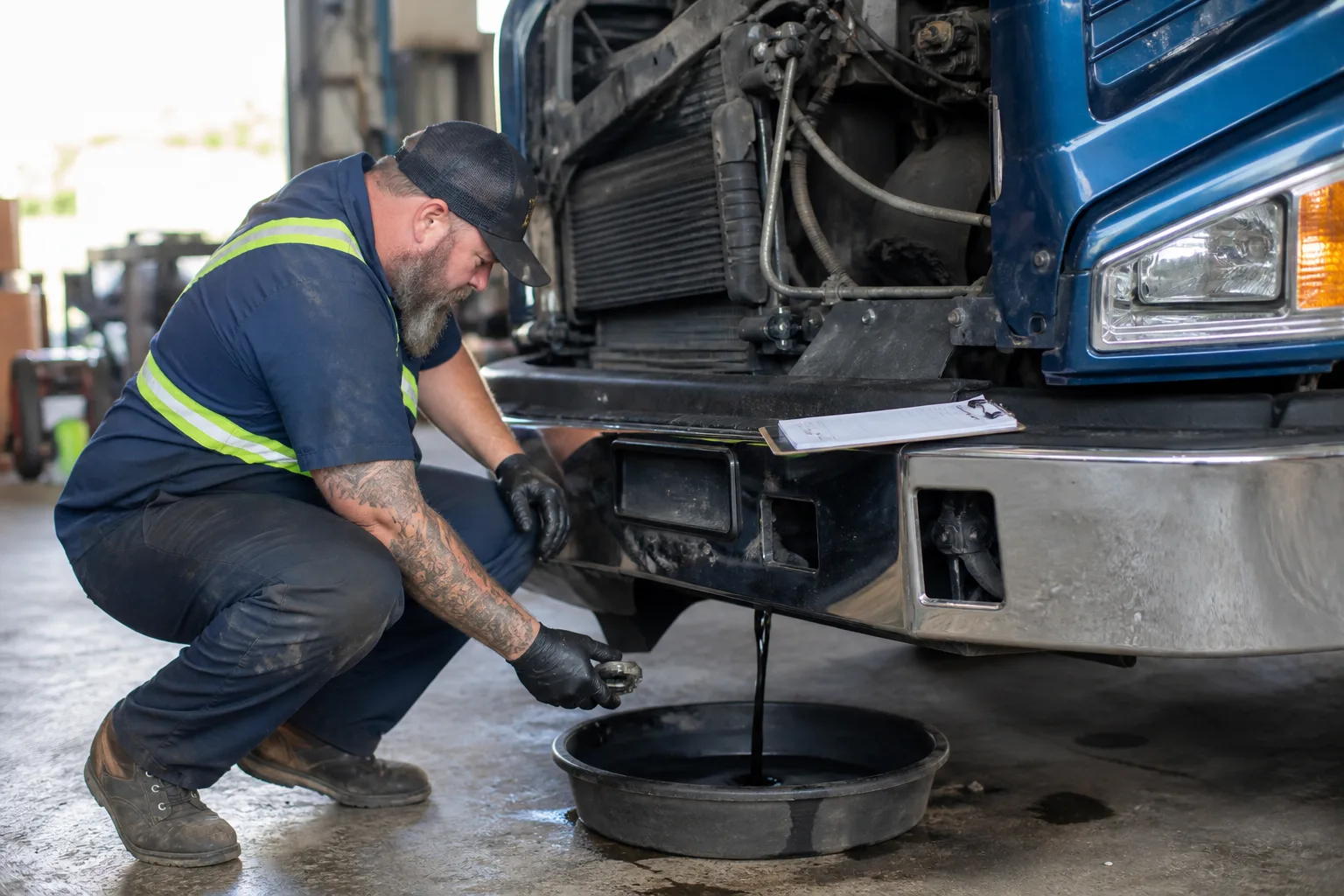
You get a real time before anyone rolls, and the price before the work starts. No motor club runaround and no waiting on a callback.
Harbor Freight DC in Elwood drives regional and national distribution logistics. The distribution center operates 24/7, routing tools, equipment, and merchandise to retail stores across the Midwest and beyond. A single tractor breakdown at the loading dock or on access roads can back up 5–10 trailers scheduled for departure, multiplying delays nationally. Peak outbound windows (early morning, 6–8 AM, and afternoon, 2–4 PM) see 40–50 trucks staging for dispatch. Winter weather during peak windows can snarl the entire operation; RRN priority dispatch during sub-zero conditions is critical to maintaining distribution schedules.
Elwood is a village in rural Will County, Illinois, United States, approximately 45 miles southwest of Chicago. The population was 2,229 at the 2020 United States census, down from 2,279 in 2010.
Elwood is a small village of 2,229 residents 45 miles southwest of Chicago, but punches far above its weight as a regional distribution hub. Harbor Freight Tools Distribution Center (3401 S Brandon Rd) anchors the area as the primary employer, staging trucks for nationwide retail distribution. While Elwood itself has limited highway presence on state mapping, the village is adjacent to I-55 access and benefits from proximity to Joliet’s I-55/I-80 interchange zone. Local roads (Township Roads, County Routes) route trucks between the distribution center and I-55 ramps, creating a consistent stream of relay traffic toward Chicago’s warehouse district and regional markets. Breakdowns at or near Harbor Freight DC create urgent scheduling impacts; a disabled trailer can delay dozens of outbound shipments across the nation.
Winter weather in Elwood follows the Chicago metropolitan pattern: December through March brings ice storms, heavy snow, and sub-zero cold. The village’s rural setting provides less urban heat-island insulation; temperatures can drop 3–5 degrees lower than downtown Chicago on clear nights. Moisture from farm ponds and small waterways accelerates frost and black-ice formation on local road surfaces near distribution facilities. Salt application on access roads is lighter than urban zones; rural roads may become icy and treacherous. Battery failures and fuel gelling are more common here due to colder ambient; trucks staging overnight in frozen conditions face mechanical challenges.
Road Rescue Network serves Elwood with priority focus on Harbor Freight DC logistics and regional warehouse operations. We maintain 24/7 mobile dispatch for local roads connecting Elwood to I-55 and Joliet corridors. Vendor partnerships include River Valley Truck Parts (Kankakee), FleetPride Chicago, and independent shops trained in rapid-response warehouse emergencies. Winter-specialty services include fuel additives, battery exchange, and roadside diagnostics calibrated for sub-zero conditions. We coordinate directly with Harbor Freight logistics to preserve dock scheduling and minimize cargo staging delays during breakdowns. Our network extends into Channahon, Minooka, and the greater Will County warehouse cluster.
Fleet maintenance services are a scheduled program that keeps a company's vehicles serviced, inspected, documented, and legal — as opposed to a repair shop you call after something fails. A real program in Elwood has four parts. First, preventive service at defined intervals: oil and filters, brakes, tires, fluids, and inspection items, usually tiered as A, B, and C services with the deeper work at longer intervals. Second, federal compliance work: the annual 396.17 inspection on every commercial unit, driver vehicle inspection reports collected and defects certified as repaired, and brake work documented by a qualified inspector. Third, records — a maintenance file per vehicle, because in an audit the file is the evidence and a well-maintained truck with no paperwork looks the same as a neglected one. Fourth, the repair work the program generates, done at your yard where possible. What separates a program from a vendor relationship is that it is scheduled and measured: cost per mile, unscheduled downtime, and roadside call frequency should all be moving in the right direction, and if they are not, the intervals are wrong.
Day to day it is three streams of work running at once. The scheduled stream is PM services coming due by mileage, hours, or calendar — lube and filters, brake measurement and adjustment, tire rotation and pressure, air system checks, coolant and DEF testing, and the annual federal inspection. The reactive stream is defects: whatever drivers report on their DVIRs, whatever a technician finds during a PM, and whatever fails between services. The administrative stream is the one fleets underestimate — certifying DVIR repairs, filing repair orders against the right unit, tracking annual inspection expiries, keeping inspector qualification records, and watching the Vehicle Maintenance BASIC for the violation pattern that is quietly raising your inspection frequency. In a Elwood operation the scheduled stream should be the largest of the three. When the reactive stream grows past it, the program is not preventing anything — it is just paying for breakdowns on a slower schedule.
They overlap and they are not the same thing, which matters when you compare quotes. Fleet maintenance is the physical and regulatory upkeep of the vehicles: services, repairs, inspections, and the maintenance records behind them. Fleet management is the broader commercial function — acquisition and disposal, financing and leasing, fuel programs, telematics and driver behavior, licensing and registration, insurance, and total cost of ownership analysis across the fleet. A large fleet management company will typically include maintenance inside its offering and price the whole bundle per unit per month. A maintenance provider does the upkeep and hands you the data. Which you want depends on where your gap is: if your trucks are serviced but you cannot say what a unit costs per mile, you have a management problem, and if you can produce a spreadsheet but not an annual inspection report, you have a maintenance problem. Buying the wrong one is common and expensive.
Almost always per unit per month, and the number is meaningless without the scope beside it. The structures you will encounter are a flat per-vehicle monthly fee covering a defined service list, a per-vehicle management fee with maintenance billed as performed, a cost-per-mile arrangement on defined equipment, or a full-service lease where maintenance is bundled into the lease payment. What moves the figure is fleet size, vehicle class and age, duty cycle, the service intervals you choose, whether annual inspections and compliance recordkeeping are included, and whether roadside response is attached. When comparing vendors, force the comparison onto the same footing: ask each one for the written scope — which services, at which intervals, on which equipment, with what included — because a lower per-unit price with A services only and compliance billed separately is not cheaper than a higher price with the whole program inside it. It just looks cheaper on the first page.
Follow the manufacturer's schedule as the floor, then shorten it for duty cycle. A highway tractor running long steady miles may go 25,000 miles or more between A services on extended-drain oil, while the same engine in Elwood stop-and-go work — port drayage, city delivery, vocational service — accumulates engine hours and brake cycles far faster than the odometer suggests and needs a shorter interval. That is why hours or fuel burn is often a better trigger than mileage for an urban fleet. Two dates are fixed regardless of how you set intervals: the federal annual inspection every twelve months on every commercial vehicle, and any state periodic inspection your registration requires, which runs alongside the federal one rather than replacing it. The practical test of whether your intervals are right is your own data — if unscheduled road calls and downtime are rising while PM spend is flat, the interval is too long, and the road calls are already paying the difference.
Often more worth it than for a large one, because a small fleet has no spare capacity. When a ten-truck operation puts one unit out of service, it has lost ten percent of its revenue capability for the day; a two-hundred-truck fleet reassigns the load and moves on. The federal obligations are also identical regardless of size — a three-truck carrier owes the same systematic maintenance, annual inspections, DVIR handling, and records that a national fleet does, and small carriers fail compliance reviews on paperwork far more often than on mechanical condition. Where the math genuinely changes is per-unit cost: a small fleet cannot amortize a service visit across many trucks, so per-unit pricing is higher. The honest comparison is not program cost against zero, it is program cost against what you currently spend on unscheduled repairs, road calls, and downtime — numbers most small fleets have never added up. When they do, the program is frequently already being paid for, just at retail and at the worst possible moment.
Call RRN immediately and mention Harbor Freight DC Elwood. We coordinate directly with DC logistics and warehouse operations. For mobile-repairable issues (fuel, battery, air-brake diagnostics), we typically fix on-site within 20–30 minutes. For major work (transmission, engine), we arrange fast-track towing with backup tractor coordination so your load continues to national distribution. DC appreciates early notification; we can often preserve scheduling by offloading cargo to standby unit.
Yes. RRN maintains winter-grade diesel (treated with cold-flow enhancer) in mobile delivery tankers November through March. If you’re at Harbor Freight DC or anywhere in Elwood and fuel lines are gelling, call immediately. Average delivery response is 22 minutes. We can also deliver to local truck stops (Pilot Channahon, Minooka) for pre-fueling before winter hauls.
County Road 48 is rural with lighter salt maintenance than urban roads. Ice forms quickly during freeze events. Early morning (5–8 AM) is most treacherous due to overnight frost and reduced traffic to break ice. If you’re approaching the DC during freeze warnings, add 15–20 minutes to your ETA. RRN monitors County Road 48 conditions and provides emergency recovery if you jackknife or slide. Report hazards via app so we can alert other DC-bound trucks.
Absolutely. Harbor Freight DC typically has sub-zero startup challenges during January–February extremes. RRN pre-positions heated-battery reserves at staging areas near Elwood. Call with battery failure symptoms; we’ll deploy mobile tech with replacement within 18–20 minutes. Installed battery is tested under load before departure. Driver receives recommendation for battery upgrade if rated for less than 1000 CCA for your engine.
For mobile-repairable issues: 20–30 minutes (minimal impact). For major work: 2–4 hours (DC coordinates backup tractor, your load continues). RRN coordinates with DC dispatch to minimize rescheduling by offloading to standby unit or towing to priority-bay shop. Worst-case (multi-hour major repair): 6–8 hour delay, but RRN works to preserve your place in national distribution queues.
Elwood itself has no dedicated truck stop, but nearby: Pilot Travel Center (Channahon, 11 miles), Love’s (Channahon, 15 miles). Pilot Minooka (301 Ridge Rd) is 8 miles away. RRN can arrange overnight warehouse staging at Harbor Freight or nearby facilities if your load is compatible. For extended repairs, we coordinate with FleetPride Chicago or River Valley Truck Parts (Kankakee) with bay overnight staging.
Elwood doesn’t have a dedicated DOT station, but RRN coordinates inspections at Will County authorized facilities (Joliet area, 12 miles). Mobile pre-trip inspections for brake, lighting, tire, hazmat compliance average 24 minutes at Harbor Freight DC or roadside. Schedule in advance through app. For pre-departure checks at DC, we can often coordinate inspection at loading dock area.
Peak outbound (6–8 AM, 2–4 PM) creates stop-and-go queuing on County Road 48. Preventive: (1) Check transmission fluid monthly. (2) Monitor temperature gauge during dock staging. (3) Shift to neutral during extended stops. (4) Schedule cooler flush annually to remove salt/debris. If temperature climbs during staging, exit queue, cool 10 minutes, re-enter. RRN mobile diagnostics can check cooler condition roadside (28 min).
Call RRN immediately (5–30-min response). Mobile fuel-system tech will drain gelled fuel, flush filter, deliver winter-grade diesel with anti-gel. Truck typically rolls within 20–30 minutes. For future cold seasons, pre-treat all fuel loads with approved cold-flow additive and consider block heater installation. RRN can refer you to equipment vendors for engine-block heater setup.
Yes. Mobile air-brake service available on all local roads (County Road 48, I-55 access) and I-55 corridor from Elwood. Average response 30 minutes. Common issues: pressure loss from cold-weather moisture icing in compressor discharge, trailer supply-line leaks (salt corrosion), valve stiction. We carry replacement valves, hose couplings, and desiccant cartridges. Pressure-test confirms integrity before you roll.

Elwood runs about 2,229 people and sits in Will County, inside the Elwood Warehouse District (Chicago Metropolitan Extended). We take the call, find the closest crew that actually does this work, and tell you what it costs before anyone turns a wheel.
Coverage in surrounding cities and metros across the same network of verified rescuers.
The same verified network of providers, dispatched 24/7 across every major Illinois metro and freight corridor.
Whether the truck is sitting in Elwood or out toward Minooka, it is the same phone number and the same crews. One call, day or night.
Road Rescue Network is actively recruiting verified fleet maintenance providers in the Elwood metro. Heavy traffic, real fleet leads, no auction race-to-the-bottom, straight rescuer-to-customer dispatch with confirmed pricing.
We send Elwood fleet maintenance calls directly to verified rescuers in your service radius. Apply once. Insurance & DOT verified. Live dispatch, fleet accounts, transparent pricing, no motor-club shave-down.
Deep-dive guide on choosing the right provider, common pitfalls, and what to expect on a service call.
OpenOpen positions at our network rescuers, full-time, part-time, and 1099 contract.
OpenOn-site photos from recent calls, see the work, not just the marketing.
OpenNetwork technicians carry diagnostic equipment, OEM-spec tooling, and common-failure parts for every major fleet maintenance brand on the road. Out-of-stock specifics order in within 24 hours.
Service trucks dispatch routinely to these locations across the metro freight corridors.


Local parts houses and diesel suppliers used by network mechanics for time-critical roadside repairs.
Major shippers, distribution centers, and industrial freight nodes generating outbound and inbound truck volume.
Three steps from the call to a cleared scene. Same flow whether you call from a fleet desk or the shoulder of an interstate.
Unit list, ages, duty cycles, current intervals, and whatever maintenance records exist. A Elwood quote written without this is a guess, and the survey routinely finds units that are past an annual inspection nobody was tracking.
Which services, at which intervals, on which units, with what included. This is the document that makes a Elwood program comparable to another vendor's — and the one most quotes leave out.
Work planned against your parking and load calendar, at your Elwood yard where possible, overnight or on weekends where that keeps trucks earning.
Network rescuers accept all major credit cards, fleet cards, and consumer payment apps. Confirmed at dispatch.