01
Mobile tire service truck
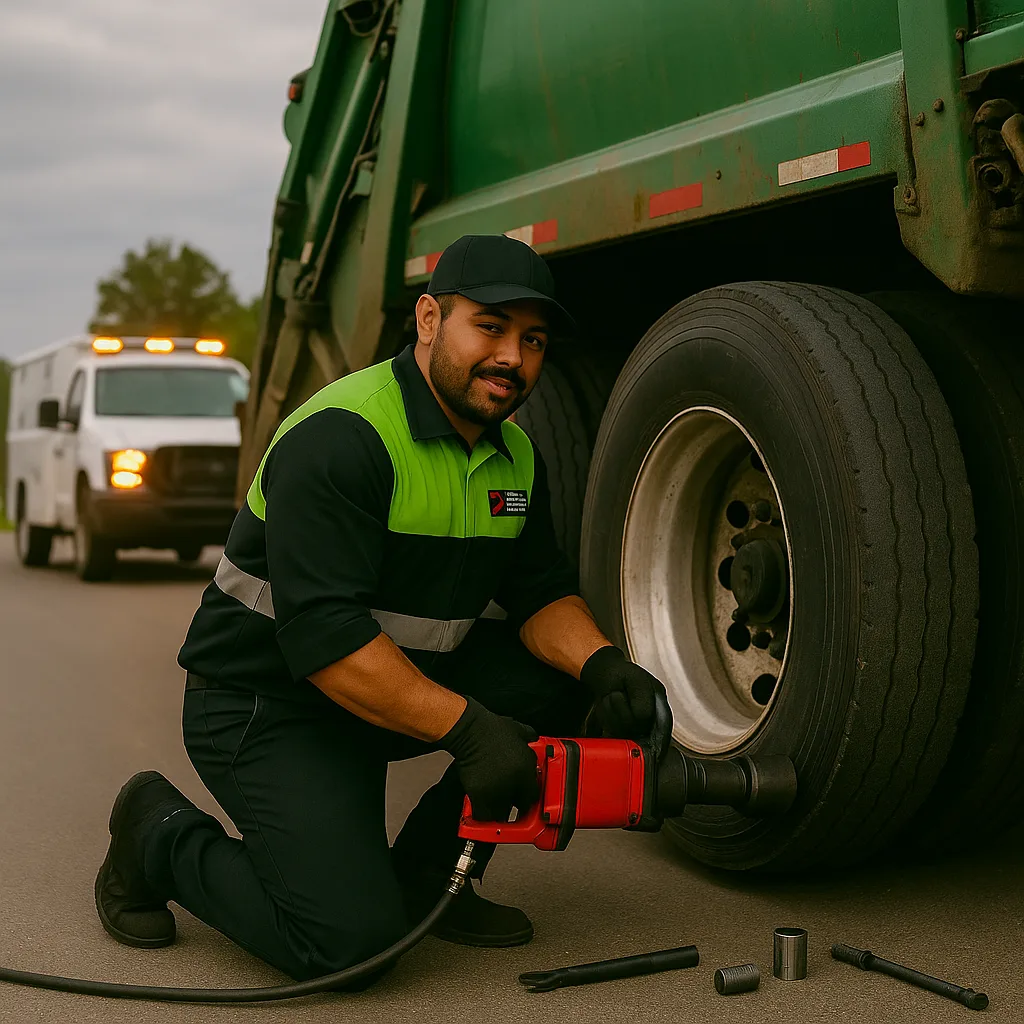
Onboard compressor, crane or hoist, tire rack
Every commercial call. A Class 8 drive tire is heavy enough that the hoist is a safety device, not a convenience.
Need mobile tire repair in Elwood? We are the 24 hour tire shop that comes to you — flat repair or full tire replacement at the shoulder, in your size, torqued properly so you don't lose a wheel twenty miles down the road. The same trucks cover Channahon, Joliet, and Minooka, so a call from outside town reaches the same people.
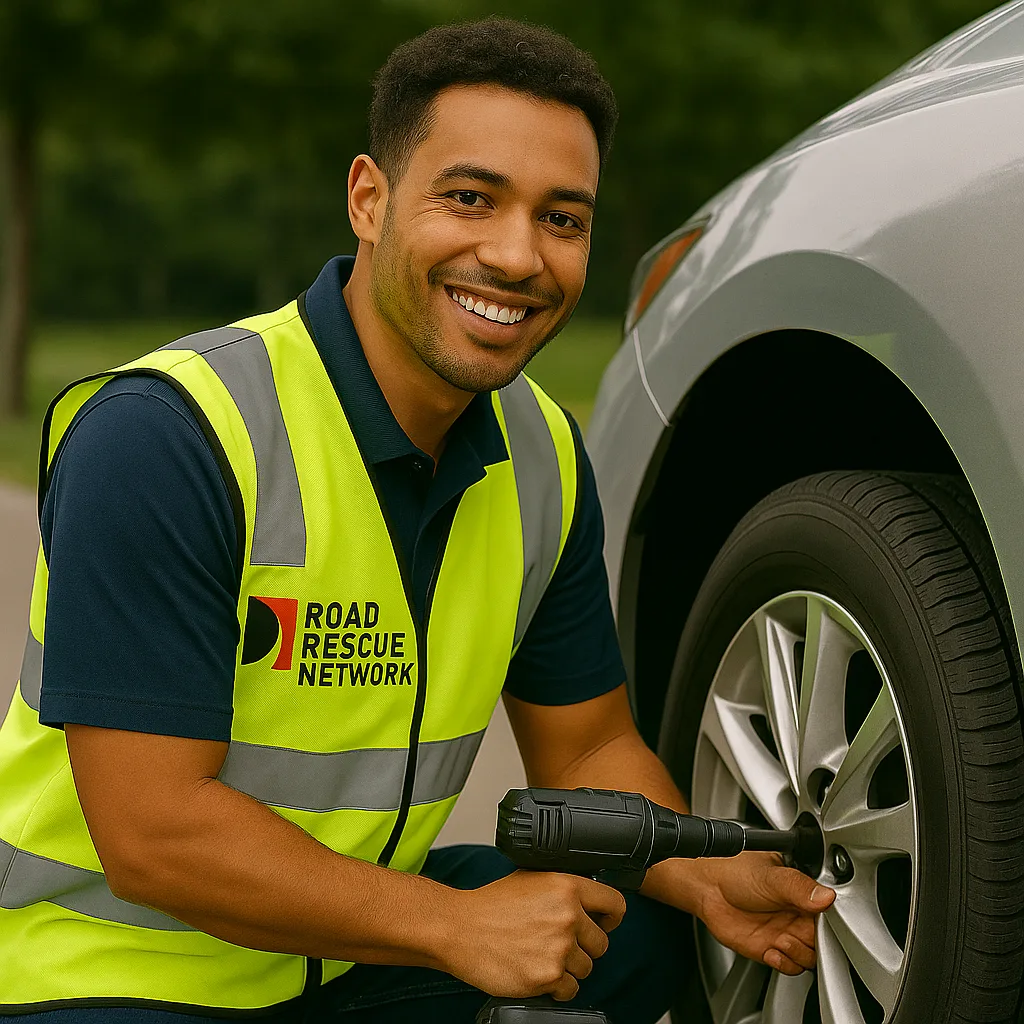
Commercial tire work at the roadside needs equipment a passenger-car tire shop does not own. This is what a Elwood service truck carries.
Onboard compressor, crane or hoist, tire rack
Every commercial call. A Class 8 drive tire is heavy enough that the hoist is a safety device, not a convenience.
Truck and trailer tire capable
Any mount or dismount at the roadside. Commercial beads do not break with hand tools.
Torque wrench or calibrated multiplier
Every wheel installation. The impact gun spins the nut on; the torque tool is what makes it correct.
OSHA-compliant restraining device
Any tire inflated off the vehicle. A commercial tire failing during inflation carries lethal energy — this is a mandatory control, not best practice.
Calibrated depth gauge, dual-foot chuck
Every call. Documented readings are what make a DOT compliance claim defensible later.
Inside patch, vulcanizing capability
Repairable injuries. An inside repair is a real repair; an outside plug is a temporary measure.
Cones, triangles, scene lighting, high-vis
Rolls on every interstate call. Working the traffic side of a truck in the dark is the highest-risk part of this job.
Common steer, drive, and trailer sizes
Carried so a call finishes on the first visit. Dispatch confirming your size is checking stock, not stalling.
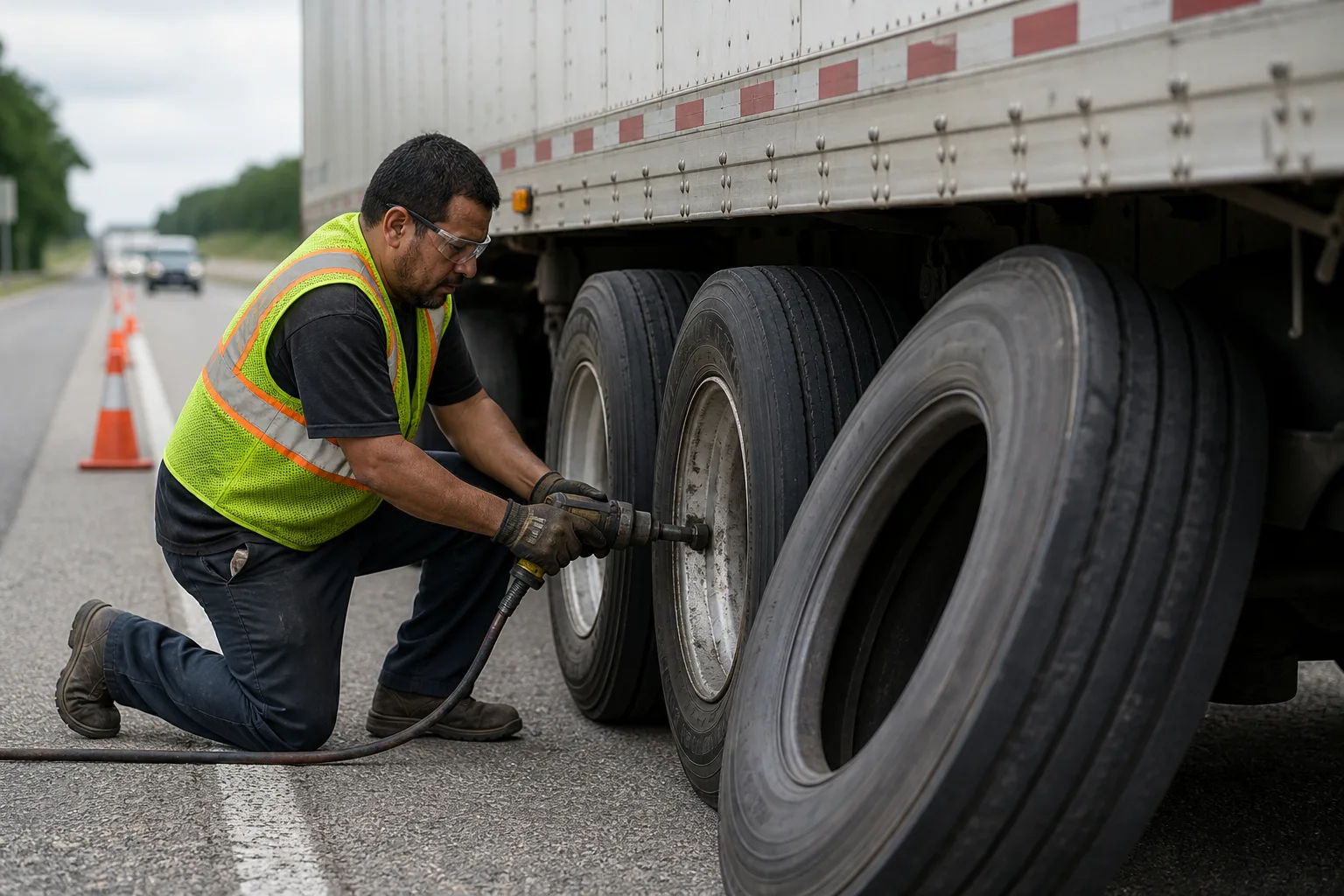
One call puts a mobile tire repair unit on the road to you anywhere in Elwood and the surrounding Will County. Tell us where you are stopped and we do the rest.
Roadside and on-site tire work across the Elwood metro — steer, drive, trailer, and light-truck positions. Repaired where it is repairable, replaced where it is not, and torqued to spec either way.
New or casing-matched tire mounted and balanced at the shoulder or the dock. The standard Elwood road-call, and the reason a blowout does not have to become a tow.
Repaired properly from the inside when the injury is in the repairable crown area. A Elwood plug alone from the outside is a temporary fix that industry standards do not recognize as a repair.
Correcting under-inflation across the unit, which is what causes most of the Elwood blowouts we get called to in the first place. Underinflated duals run hot and fail at highway speed.
Mounting a tire you already own onto the wheel on the truck, or onto your spare, so a Elwood fleet using its own casing program does not pay for inventory twice.
Stems, cores, extensions, and sensor service. A slow leak on a Elwood inner dual is very often the stem rather than the tire, and it is a fraction of the cost to find out.
Dispatch to a live shoulder with cones, lighting, and a shadow position. Elwood interstate tire work is done from the traffic side more often than anyone would like, so how a truck sets up matters.
The most safety-critical position on the vehicle and the one with the strictest tread requirement. A Elwood steer failure at speed is a control event, not an inconvenience.
Drive axle duals, including matched-pair replacement. Mismatched diameters on a Elwood dual set scrub continuously and destroy both tires plus the differential over time.
Trailer tires run the highest neglect rate in any fleet because nobody walks the back of the unit. Most Elwood trailer calls are a tire that was flat before the trip started.
Wide-base single service and conversion questions. A Elwood super single carries the whole position with no companion tire, so a failure strands the unit immediately.
Diameter and tread-depth matching across a dual set within tolerance. Getting this wrong is the quiet cause of repeat Elwood failures on the same position.
Retread fitment on legal positions and casing management for Elwood fleets. Retreads are prohibited on the steering axle of buses and are a routine, legal, economical choice elsewhere.
Cracked, bent, and corroded wheels swapped out. A Elwood rim that failed once will fail again — replacing the tire on a damaged wheel is buying the same road call twice.
Sheared studs and stretched fasteners replaced. A wheel-off event on a Elwood highway is catastrophic, and it nearly always starts as one loose or damaged fastener.
Calibrated torque at installation, plus the re-torque interval afterward. An impact gun alone is a guess, and the re-torque is the step that gets skipped and causes wheel-offs.
Seals, bearings, and oil-bath hubs when the tire failure exposed a wheel-end problem. A Elwood hub running hot will take out the new tire too.
Different torque values, different corrosion behavior, different failure modes. A Elwood tech torquing aluminum to a steel spec is over-clamping the wheel.
Full fastener and hub inspection after a separation event, before the unit moves again anywhere in Elwood.
Federal minimums are 4/32 on the steering axle and 2/32 on all others. A Elwood unit below that is out of service at roadside, and the fine is the cheap part.
Tire and wheel items caught before an inspector catches them. Tires are among the most frequently cited defects in Elwood roadside inspections.
Pressure, tread, and wear-pattern surveys on a Elwood yard schedule. Every dollar here removes several from the emergency road-call line.
Tracking, inspecting, and routing casings to retread. A Elwood fleet that manages casings well runs meaningfully lower cost per mile.
Feathering, cupping, and one-sided wear read as symptoms of alignment, inflation, or suspension faults. Replacing a Elwood tire without reading the old one guarantees the same failure again.
Old casings removed and disposed of under state waste-tire rules. Leaving them in a Elwood yard creates a regulatory problem of its own.
Roadside tire work is a service call plus the tire, and the two should never arrive as one number. Here is what a Elwood invoice is actually made of.
Getting the truck and the tech to you, billed once regardless of how many tires get touched. The number to compare between providers.
Distance beyond the core service area. Ask whether it counts from their shop or your location — on a rural interstate call that is the whole difference.
The tire itself, which varies enormously by position, brand, and load range. Bringing your own casing removes this line entirely.
Charged per tire and separate from the service call. Doing two tires on one visit is far cheaper than two visits.
A proper inside repair costs a fraction of a new tire. Whether the injury sits in the repairable crown area decides it, and an honest tech will show you.
Overnight and holiday road calls price above daytime. Most blowouts do not happen at 10 a.m. on a Tuesday.
Damaged rims, sheared studs, and stems billed as parts. A tire failure frequently takes the wheel with it.
The re-torque follow-up may be a separate visit or a separate line. Skipping it is how wheel-off events happen — do not decline this one.
A usable casing carries trade value against a retread program. Fleets that track this see real money; fleets that do not leave it on the shoulder.
Waste tire disposal is regulated and charged per tire in most states.
Extended waits for a police traffic break or lane closure on a live shoulder are billable time.
The same tire fitted in your yard on a Tuesday costs materially less than fitted on I-95 at midnight. Tire PM is the cheapest line item on this page.
Road Rescue Network does not set a member operator's rates. What the network does is get the road call, the tire, and the labor quoted as separate lines before the truck rolls — and confirm the operator actually stocks your size first.
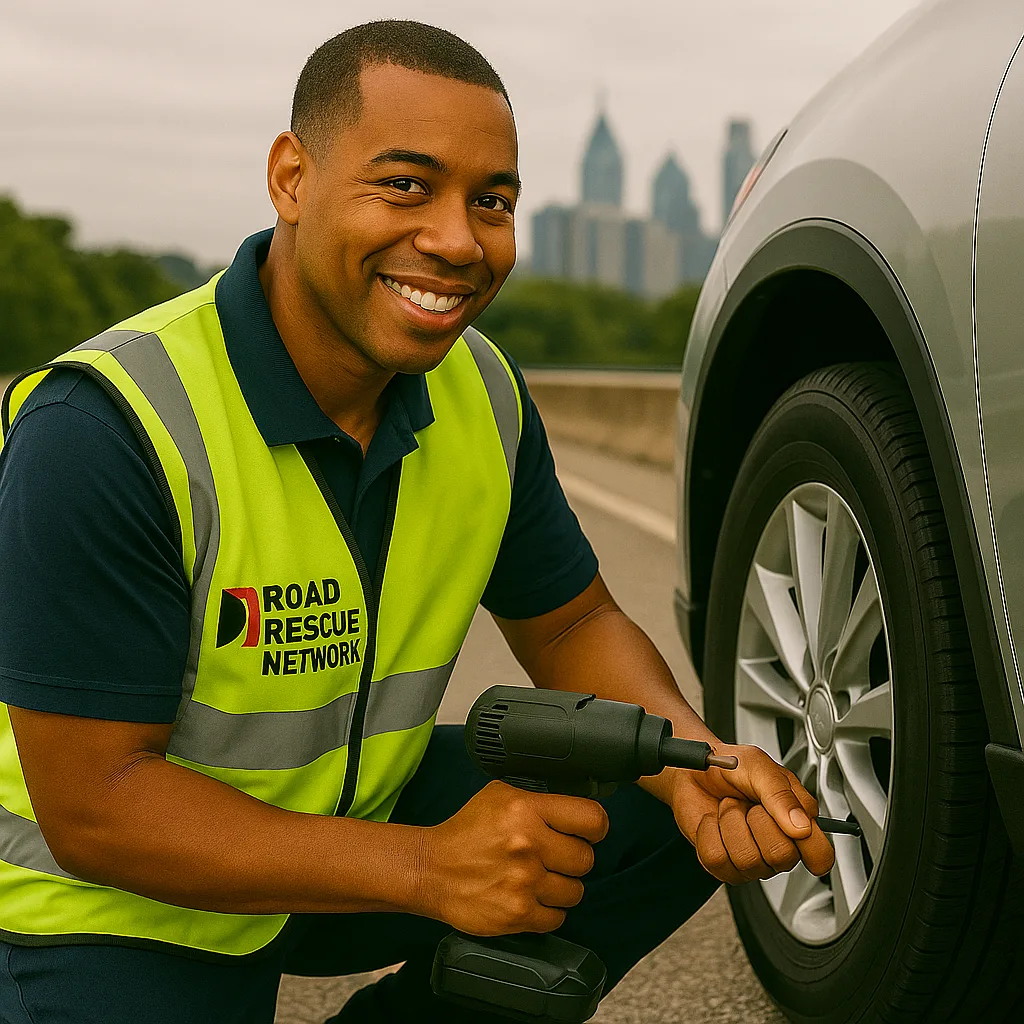
The same crews that run Elwood also cover Channahon (8 mi), Joliet (12 mi) and Minooka (6 mi), so a call from either side of Will County reaches the same desk.
Each service links to local response times, rescuer coverage, and recent dispatched jobs in this metro.
Patterns observed across recent dispatch data in this metro, by service type and corridor.
5:30 AM winter morning, minus-eight-degree ambient at Harbor Freight DC (Elwood). Loaded trailer from overnight freeze-check ready for 6 AM departure. Driver starts tractor; fuel lines gelled from sub-zero overnight cold. No engine cranking. RRN mobile fuel-system tech dispatches immediately (contacted by DC dispatch). Drains gelled fuel, flushes filter housing with heated solvent, installs new filter, delivers premium winter-grade diesel with anti-gel additive. Truck rolls by 6:15 AM, preserves national distribution schedule. DC postpones one backup tractor; no cascading delays.
Morning dock arrival, loaded tractor with time-sensitive shipment. Backup attempted; battery voltage collapses. RRN dispatches immediately with reserve battery. Mobile tech performs load-test, confirms battery failure (cold-rated battery too old for extreme cold). Swaps battery, cleans corrosion, applies terminal upgrade. Truck rolls within 18 minutes. Driver receives new battery recommendation; DC shifts load to backup unit if needed, minimal impact.
Heavy snow overnight, icy morning. Loaded tractor exiting Harbor Freight DC on County Road 48 hits unexpected ice, jackknifes. Trailer blocks warehouse gate access. RRN dual-unit recovery immediately mobilized. First unit chains tractor, second chains trailer. Coordinated extraction rights vehicles over 45 minutes. DC temporarily diverts outbound traffic to alternate staging area. No cargo damage; tractor towed to FleetPride (Chicago) for frame/suspension inspection. DC resumes normal outbound flow.
Truck departing Elwood on I-55 northbound toward Chicago distribution. Alternator bearing fails; no charging. Battery slowly discharges over 8 miles. Low-voltage warning lights; driver pulls to shoulder before losing all power. RRN mobile diagnostics arrives, confirms alternator failure. Loads battery to prevent stranding, coordinates controlled tow to FleetPride Chicago with priority bay. Load transferred to backup tractor at staging; on-time delivery preserved. RRN coordination prevents dock window loss.
County Road 48 to Harbor Freight DC congestion: multiple trucks queued for loading dock, stop-and-go over 2 miles. Transmission temperature climbs on one tractor. Driver notices delayed shifts; pulls aside before DC gate. RRN mobile tech checks transmission fluid (low) and cooler (salt-fouled). Top-off and cooler-line pressure test restore function. Truck advances into dock sequence; no rescheduling impact. Driver advised to schedule cooler flush and transmission service during maintenance window.
Trailer approaching Harbor Freight DC loading dock; air-brake pressure drops from 120 PSI to 75 PSI. Driver feels loss of brake response. Pulls aside on County Road 48 near warehouse. RRN air-brake tech dispatched; pressure-tests system, identifies slow leak in trailer supply line. Replaces damaged hose coupling with new assembly, recharges to spec. Pressure holds at 120 PSI. Truck resumes dock entry within 22 minutes; no load rescheduling.
Tires are among the most-cited defects in roadside inspections, and the rules are specific and enforceable. What governs a commercial tire in Elwood, Illinois.
Federal safety regulations set 4/32 of an inch of tread on the steering axle and 2/32 on all other axles. Below that the vehicle is out of service at roadside — measured at the shallowest point, not the average.
Beyond tread depth, an inspector will place a vehicle out of service for exposed belt or cord, a visible bulge, a flat or audibly leaking tire, or an unsafe repair in the sidewall. Any one of those ends the trip where it stands.
Regrooved, recapped, or retreaded tires are prohibited on the front steering axle of buses. Retreads remain legal, economical, and routine on other positions across the industry.
A tire's load capacity is a function of its inflation pressure. Running underinflated is not merely inefficient, it silently overloads the tire, builds heat, and is the leading cause of highway blowouts.
Loose or damaged fasteners are an out-of-service item. Torque at installation and the follow-up re-torque are the entire defense against a wheel separation.
Scrap tires are regulated waste in most states, with handling and disposal requirements that fall on whoever generates them. That is the disposal line on your invoice.
You get a real time before anyone rolls, and the price before the work starts. No motor club runaround and no waiting on a callback.
Harbor Freight DC in Elwood drives regional and national distribution logistics. The distribution center operates 24/7, routing tools, equipment, and merchandise to retail stores across the Midwest and beyond. A single tractor breakdown at the loading dock or on access roads can back up 5–10 trailers scheduled for departure, multiplying delays nationally. Peak outbound windows (early morning, 6–8 AM, and afternoon, 2–4 PM) see 40–50 trucks staging for dispatch. Winter weather during peak windows can snarl the entire operation; RRN priority dispatch during sub-zero conditions is critical to maintaining distribution schedules.
Elwood is a village in rural Will County, Illinois, United States, approximately 45 miles southwest of Chicago. The population was 2,229 at the 2020 United States census, down from 2,279 in 2010.
Elwood is a small village of 2,229 residents 45 miles southwest of Chicago, but punches far above its weight as a regional distribution hub. Harbor Freight Tools Distribution Center (3401 S Brandon Rd) anchors the area as the primary employer, staging trucks for nationwide retail distribution. While Elwood itself has limited highway presence on state mapping, the village is adjacent to I-55 access and benefits from proximity to Joliet’s I-55/I-80 interchange zone. Local roads (Township Roads, County Routes) route trucks between the distribution center and I-55 ramps, creating a consistent stream of relay traffic toward Chicago’s warehouse district and regional markets. Breakdowns at or near Harbor Freight DC create urgent scheduling impacts; a disabled trailer can delay dozens of outbound shipments across the nation.
Winter weather in Elwood follows the Chicago metropolitan pattern: December through March brings ice storms, heavy snow, and sub-zero cold. The village’s rural setting provides less urban heat-island insulation; temperatures can drop 3–5 degrees lower than downtown Chicago on clear nights. Moisture from farm ponds and small waterways accelerates frost and black-ice formation on local road surfaces near distribution facilities. Salt application on access roads is lighter than urban zones; rural roads may become icy and treacherous. Battery failures and fuel gelling are more common here due to colder ambient; trucks staging overnight in frozen conditions face mechanical challenges.
Road Rescue Network serves Elwood with priority focus on Harbor Freight DC logistics and regional warehouse operations. We maintain 24/7 mobile dispatch for local roads connecting Elwood to I-55 and Joliet corridors. Vendor partnerships include River Valley Truck Parts (Kankakee), FleetPride Chicago, and independent shops trained in rapid-response warehouse emergencies. Winter-specialty services include fuel additives, battery exchange, and roadside diagnostics calibrated for sub-zero conditions. We coordinate directly with Harbor Freight logistics to preserve dock scheduling and minimize cargo staging delays during breakdowns. Our network extends into Channahon, Minooka, and the greater Will County warehouse cluster.
Call RRN immediately and mention Harbor Freight DC Elwood. We coordinate directly with DC logistics and warehouse operations. For mobile-repairable issues (fuel, battery, air-brake diagnostics), we typically fix on-site within 20–30 minutes. For major work (transmission, engine), we arrange fast-track towing with backup tractor coordination so your load continues to national distribution. DC appreciates early notification; we can often preserve scheduling by offloading cargo to standby unit.
Yes. RRN maintains winter-grade diesel (treated with cold-flow enhancer) in mobile delivery tankers November through March. If you’re at Harbor Freight DC or anywhere in Elwood and fuel lines are gelling, call immediately. Average delivery response is 22 minutes. We can also deliver to local truck stops (Pilot Channahon, Minooka) for pre-fueling before winter hauls.
County Road 48 is rural with lighter salt maintenance than urban roads. Ice forms quickly during freeze events. Early morning (5–8 AM) is most treacherous due to overnight frost and reduced traffic to break ice. If you’re approaching the DC during freeze warnings, add 15–20 minutes to your ETA. RRN monitors County Road 48 conditions and provides emergency recovery if you jackknife or slide. Report hazards via app so we can alert other DC-bound trucks.
Absolutely. Harbor Freight DC typically has sub-zero startup challenges during January–February extremes. RRN pre-positions heated-battery reserves at staging areas near Elwood. Call with battery failure symptoms; we’ll deploy mobile tech with replacement within 18–20 minutes. Installed battery is tested under load before departure. Driver receives recommendation for battery upgrade if rated for less than 1000 CCA for your engine.
For mobile-repairable issues: 20–30 minutes (minimal impact). For major work: 2–4 hours (DC coordinates backup tractor, your load continues). RRN coordinates with DC dispatch to minimize rescheduling by offloading to standby unit or towing to priority-bay shop. Worst-case (multi-hour major repair): 6–8 hour delay, but RRN works to preserve your place in national distribution queues.
Elwood itself has no dedicated truck stop, but nearby: Pilot Travel Center (Channahon, 11 miles), Love’s (Channahon, 15 miles). Pilot Minooka (301 Ridge Rd) is 8 miles away. RRN can arrange overnight warehouse staging at Harbor Freight or nearby facilities if your load is compatible. For extended repairs, we coordinate with FleetPride Chicago or River Valley Truck Parts (Kankakee) with bay overnight staging.
Elwood doesn’t have a dedicated DOT station, but RRN coordinates inspections at Will County authorized facilities (Joliet area, 12 miles). Mobile pre-trip inspections for brake, lighting, tire, hazmat compliance average 24 minutes at Harbor Freight DC or roadside. Schedule in advance through app. For pre-departure checks at DC, we can often coordinate inspection at loading dock area.
Peak outbound (6–8 AM, 2–4 PM) creates stop-and-go queuing on County Road 48. Preventive: (1) Check transmission fluid monthly. (2) Monitor temperature gauge during dock staging. (3) Shift to neutral during extended stops. (4) Schedule cooler flush annually to remove salt/debris. If temperature climbs during staging, exit queue, cool 10 minutes, re-enter. RRN mobile diagnostics can check cooler condition roadside (28 min).
Call RRN immediately (5–30-min response). Mobile fuel-system tech will drain gelled fuel, flush filter, deliver winter-grade diesel with anti-gel. Truck typically rolls within 20–30 minutes. For future cold seasons, pre-treat all fuel loads with approved cold-flow additive and consider block heater installation. RRN can refer you to equipment vendors for engine-block heater setup.
Yes. Mobile air-brake service available on all local roads (County Road 48, I-55 access) and I-55 corridor from Elwood. Average response 30 minutes. Common issues: pressure loss from cold-weather moisture icing in compressor discharge, trailer supply-line leaks (salt corrosion), valve stiction. We carry replacement valves, hose couplings, and desiccant cartridges. Pressure-test confirms integrity before you roll.
Elwood runs about 2,229 people and sits in Will County, inside the Elwood Warehouse District (Chicago Metropolitan Extended). We take the call, find the closest crew that actually does this work, and tell you what it costs before anyone turns a wheel.
Coverage in surrounding cities and metros across the same network of verified rescuers.
The same verified network of providers, dispatched 24/7 across every major Illinois metro and freight corridor.
Whether the truck is sitting in Elwood or out toward Minooka, it is the same phone number and the same crews. One call, day or night.
Road Rescue Network is actively recruiting verified mobile tire repair providers in the Elwood metro. Heavy traffic, real fleet leads, no auction race-to-the-bottom, straight rescuer-to-customer dispatch with confirmed pricing.
We send Elwood mobile tire repair calls directly to verified rescuers in your service radius. Apply once. Insurance & DOT verified. Live dispatch, fleet accounts, transparent pricing, no motor-club shave-down.
Deep-dive guide on choosing the right provider, common pitfalls, and what to expect on a service call.
OpenOpen positions at our network rescuers, full-time, part-time, and 1099 contract.
OpenOn-site photos from recent calls, see the work, not just the marketing.
OpenNetwork technicians carry diagnostic equipment, OEM-spec tooling, and common-failure parts for every major mobile tire repair brand on the road. Out-of-stock specifics order in within 24 hours.
Service trucks dispatch routinely to these locations across the metro freight corridors.


Local parts houses and diesel suppliers used by network mechanics for time-critical roadside repairs.
Major shippers, distribution centers, and industrial freight nodes generating outbound and inbound truck volume.
Three steps from the call to a cleared scene. Same flow whether you call from a fleet desk or the shoulder of an interstate.
Steer, drive, or trailer; the size off the sidewall; and whether it is flat, damaged, or gone. That tells Elwood dispatch whether this is a repair, a swap onto your casing, or a tire we need to be carrying.
We confirm the operator has your size on the truck and send the road call, the tire, and the labor as separate numbers. Nothing wastes a Elwood hour like a service truck arriving without the tire.
Repairable injuries get a proper inside repair. Replacements get mounted, inflated in a restraint, torqued with a calibrated tool, and you get the re-torque interval before we leave you in Elwood.
Network rescuers accept all major credit cards, fleet cards, and consumer payment apps. Confirmed at dispatch.