01
Qualified inspector
Meets 49 CFR 396.19 training and experience requirements, with the qualification file to prove it
Every annual inspection. This is the requirement most commonly missed on paper rather than in practice.
Annual inspection due in Elwood? We bring a qualified inspector to your yard so you're not burning driver hours to reach an appointment. First thing we check is whether you even need one yet. The same trucks cover Channahon, Joliet, and Minooka, so a call from outside town reaches the same people.
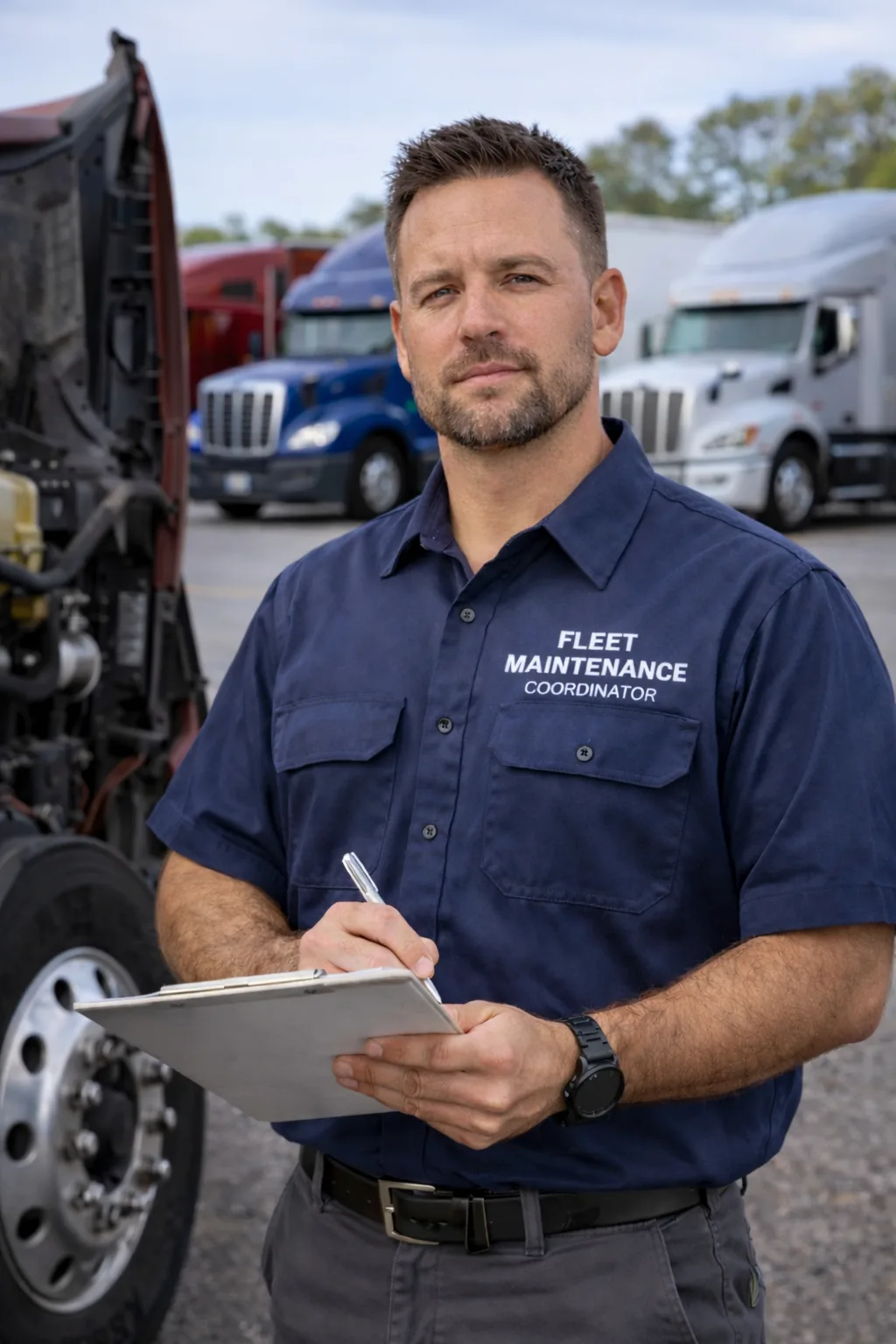
An annual inspection needs a qualified inspector, the tooling to measure rather than eyeball, and somewhere the truck can be worked safely. All three come to your Elwood yard.
Meets 49 CFR 396.19 training and experience requirements, with the qualification file to prove it
Every annual inspection. This is the requirement most commonly missed on paper rather than in practice.
Meets the separate 396.25 brake inspector standard
Any inspection or repair touching the brake system — which is nearly all of them.
Measurement tooling, air system gauges, lighting, and common repair parts on board
Inspections at your yard, so a minor finding is corrected the same visit instead of scheduling a second one.
Pushrod stroke measurement, lining thickness gauges, air loss timing
The brake section of every annual — the part that decides pass or fail more often than anything else.
ABS, chassis, and aftertreatment fault reading
Late-model equipment where an ABS lamp or an active fault affects the inspection result.
Parts and tooling for findings that would otherwise fail the inspection
Fleet inspection days, where finding six problems and fixing none of them helps nobody.
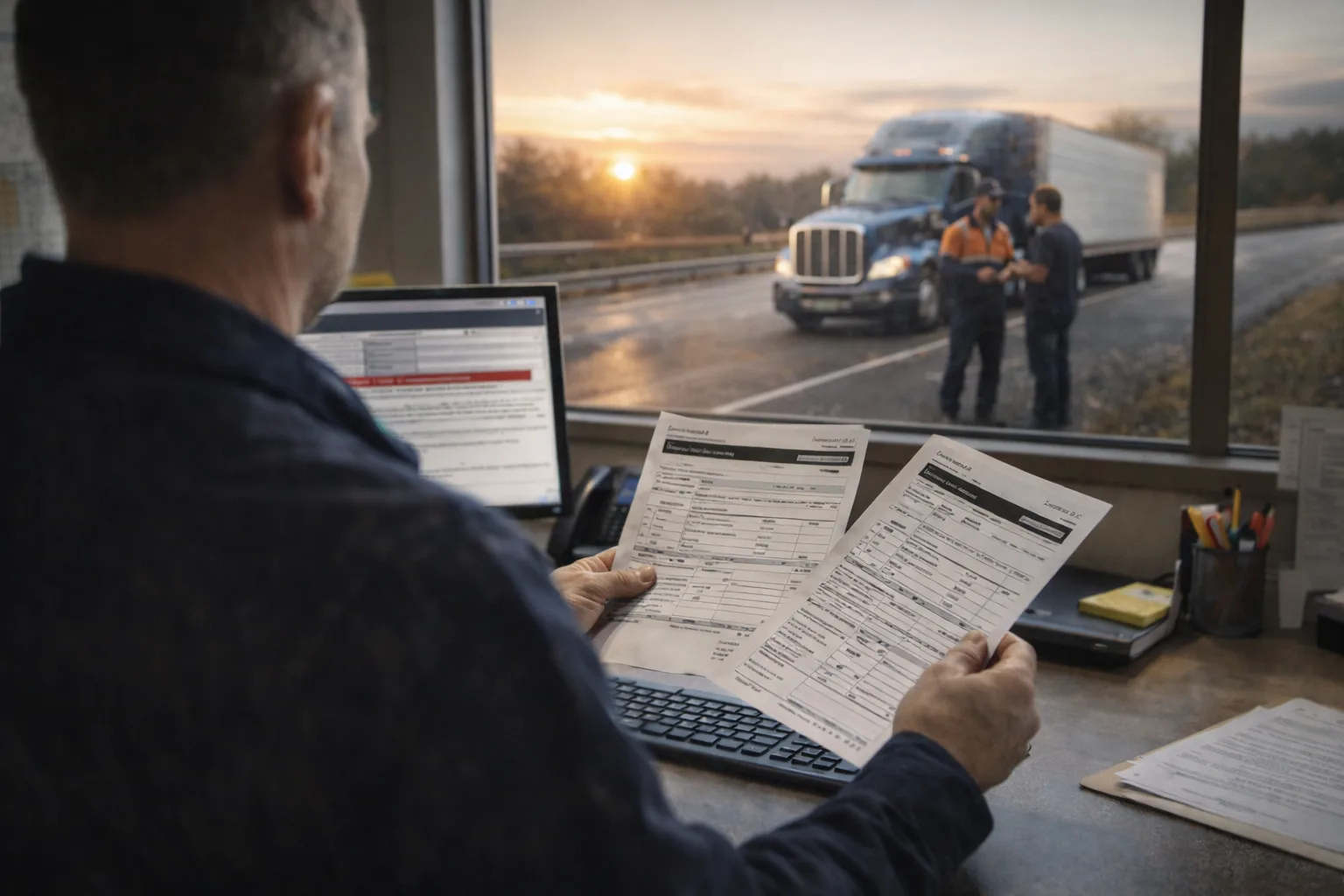
One call puts a DOT inspection unit on the road to you anywhere in Elwood and the surrounding Will County. Tell us where you are stopped and we do the rest.
The federal annual inspection and the roadside levels it interacts with, performed by a qualified inspector at your Elwood yard or terminal. Below is what is actually examined, what stops a truck, and the paperwork that has to exist afterward.
Linings and pads, drums and rotors, hoses and tubing, low-pressure warning, tractor protection, air loss rate, and pushrod travel on every wheel. This is where most Elwood trucks fail, and it is the section requiring a qualified brake inspector.
Steering wheel free play, column, gear box, pitman arm, drag link, tie rods, and ball-and-socket joints. Wear here is gradual enough that a Elwood driver adapts to it without noticing anything changed.
Springs, hangers, U-bolts, torque rods, air bags, axle positioning, plus frame members, cross members, and mounting for cracks or unauthorized welds. Frame findings are the ones most likely to surprise a Elwood owner.
Tread depth at 4/32 steer and 2/32 drive and trailer, sidewall condition, inflation, matching, and wheels and rims for cracks, elongated bolt holes, and missing fasteners. Cheap to fix beforehand, expensive at a Elwood scale.
Every required lamp and reflector, wiring condition, and connections. Lighting produces enormous violation volume nationally, and it is the single easiest Elwood pre-inspection item to clear yourself.
Fifth wheel, pintle hooks, safety devices, exhaust leaks and mounting, fuel tank security and leaks, plus windshield, wipers, mirrors, horn, and emergency equipment. The remainder of Appendix A, and where a Elwood inspection frequently finds something nobody was looking for.
The full inspection: driver credentials, hours, and a complete vehicle examination including under the truck. A Elwood Level I performed to the annual standard and documented properly can satisfy your 396.17 requirement.
Driver and vehicle, but without going underneath. The most common Elwood roadside inspection and still fully capable of producing an out-of-service order.
Credentials, medical certificate, hours of service, and required documents. No vehicle component, but violations still feed your Elwood carrier's CSA record.
A one-time examination of a specific item, and a full vehicle inspection performed without the driver present — the level typically used at a Elwood terminal or during a compliance review.
Radioactive materials transport, and electronic inspection performed wirelessly while the vehicle is in motion. The second one is expanding, and it inspects Elwood trucks that never stop.
Defects meeting the North American Standard out-of-service criteria stop the vehicle where it sits until repaired. Brakes dominate. A Elwood OOS also requires the violation be certified and returned, not merely fixed.
The report identifies the inspector, the vehicle, each component inspected, and the result. It is retained for fourteen months, with a copy where the Elwood vehicle is housed or maintained.
Where a decal is used, it goes on the vehicle showing the month and year of the inspection. Convenient at a Elwood roadside stop, but the report is the record — a decal alone does not satisfy the rule.
Evidence that whoever performed the inspection met the 396.19 requirements, and the brake inspector standard for brake work. Missing this is a violation even where the Elwood inspection itself was flawless.
Anything found and corrected has to be documented against the unit and filed. The Elwood repair order is what proves the finding was closed.
Defects a driver reported feed into the inspection picture. A Elwood annual that passes while an uncorrected DVIR defect sits open is an audit problem in itself.
The annual is due every twelve months per unit, and state periodic inspections run on their own clock. Most Elwood fleets that get caught were tracking one of the two.
An annual inspection is a small, predictable line item — the money is in what it finds. A Elwood inspection quote covers the inspection itself; repairs required to pass are separate, and knowing which is which before you book is the entire point.
The inspection fee buys the examination and the documentation. Anything that has to be corrected to pass is quoted separately. A quote that blurs the two is impossible to compare against another vendor's.
Mobile inspection at your yard costs more per unit than driving to a station, and costs less in total once you count the driver hours and the truck being out of service to get there.
Travel amortizes. Inspecting eight trailers on one visit prices very differently per unit than inspecting one, which is why fleets batch annuals rather than spreading them across the year.
A trailer inspects faster than a tractor, and a straight truck faster than a combination unit. Specialized equipment — tankers, lowboys, vocational bodies — carries additional inspection items.
A well-maintained unit inspects quickly and passes. A neglected one consumes inspector time, fails, needs repair, and needs re-inspection. Condition affects the total far more than the inspection rate does.
A lamp, a hose, or a brake adjustment corrected during the inspection visit avoids a second dispatch and a second failed attempt. This is where a mobile inspection recovers its premium.
Inspections booked ahead of expiry price normally. An inspection needed today because a unit was stopped is emergency work, and it is priced as such.
Annual inspections are quoted per unit and per visit. Repairs required to pass are quoted separately and authorized before they are performed — you will never receive an inspection invoice with repair work folded into it.
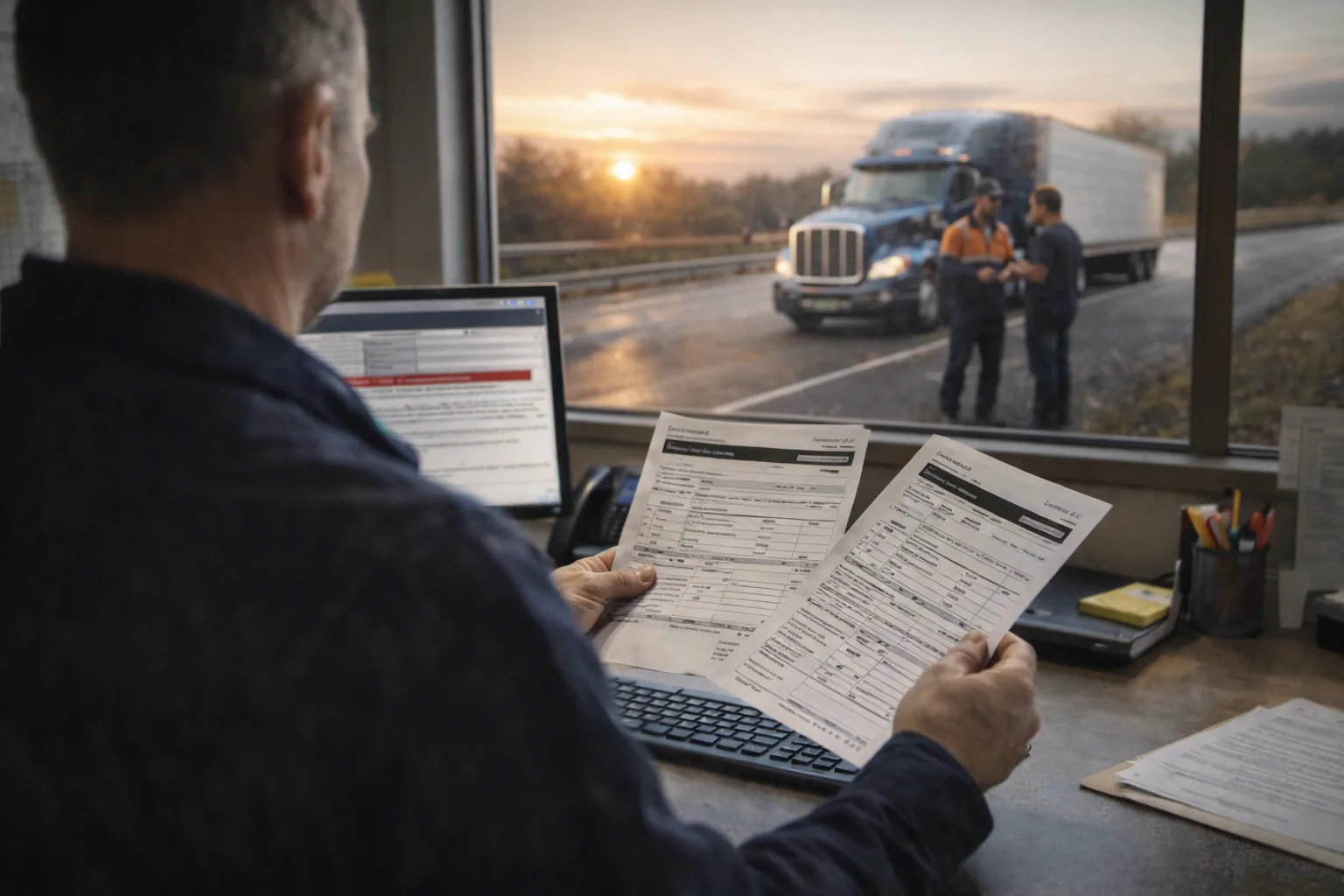
The same crews that run Elwood also cover Channahon (8 mi), Joliet (12 mi) and Minooka (6 mi), so a call from either side of Will County reaches the same desk.
Each service links to local response times, rescuer coverage, and recent dispatched jobs in this metro.
Patterns observed across recent dispatch data in this metro, by service type and corridor.
5:30 AM winter morning, minus-eight-degree ambient at Harbor Freight DC (Elwood). Loaded trailer from overnight freeze-check ready for 6 AM departure. Driver starts tractor; fuel lines gelled from sub-zero overnight cold. No engine cranking. RRN mobile fuel-system tech dispatches immediately (contacted by DC dispatch). Drains gelled fuel, flushes filter housing with heated solvent, installs new filter, delivers premium winter-grade diesel with anti-gel additive. Truck rolls by 6:15 AM, preserves national distribution schedule. DC postpones one backup tractor; no cascading delays.
Morning dock arrival, loaded tractor with time-sensitive shipment. Backup attempted; battery voltage collapses. RRN dispatches immediately with reserve battery. Mobile tech performs load-test, confirms battery failure (cold-rated battery too old for extreme cold). Swaps battery, cleans corrosion, applies terminal upgrade. Truck rolls within 18 minutes. Driver receives new battery recommendation; DC shifts load to backup unit if needed, minimal impact.
Heavy snow overnight, icy morning. Loaded tractor exiting Harbor Freight DC on County Road 48 hits unexpected ice, jackknifes. Trailer blocks warehouse gate access. RRN dual-unit recovery immediately mobilized. First unit chains tractor, second chains trailer. Coordinated extraction rights vehicles over 45 minutes. DC temporarily diverts outbound traffic to alternate staging area. No cargo damage; tractor towed to FleetPride (Chicago) for frame/suspension inspection. DC resumes normal outbound flow.
Truck departing Elwood on I-55 northbound toward Chicago distribution. Alternator bearing fails; no charging. Battery slowly discharges over 8 miles. Low-voltage warning lights; driver pulls to shoulder before losing all power. RRN mobile diagnostics arrives, confirms alternator failure. Loads battery to prevent stranding, coordinates controlled tow to FleetPride Chicago with priority bay. Load transferred to backup tractor at staging; on-time delivery preserved. RRN coordination prevents dock window loss.
County Road 48 to Harbor Freight DC congestion: multiple trucks queued for loading dock, stop-and-go over 2 miles. Transmission temperature climbs on one tractor. Driver notices delayed shifts; pulls aside before DC gate. RRN mobile tech checks transmission fluid (low) and cooler (salt-fouled). Top-off and cooler-line pressure test restore function. Truck advances into dock sequence; no rescheduling impact. Driver advised to schedule cooler flush and transmission service during maintenance window.
Trailer approaching Harbor Freight DC loading dock; air-brake pressure drops from 120 PSI to 75 PSI. Driver feels loss of brake response. Pulls aside on County Road 48 near warehouse. RRN air-brake tech dispatched; pressure-tests system, identifies slow leak in trailer supply line. Replaces damaged hose coupling with new assembly, recharges to spec. Pressure holds at 120 PSI. Truck resumes dock entry within 22 minutes; no load rescheduling.
The annual inspection is federal, so the standard is the same in Illinois as everywhere else. What changes by state is whether a separate periodic inspection applies on top of it — and that is where Elwood fleets most often get caught.
Every commercial motor vehicle must pass a comprehensive inspection at least once every twelve months. The vehicle must be inspected against the minimum periodic inspection standards in Appendix A to Part 396, and proof of the inspection must be retained. A vehicle operated without a current annual inspection is in violation regardless of its actual mechanical condition.
A roadside inspection performed to the periodic inspection standard — in practice a North American Standard Level I — can meet the annual requirement, provided the documentation is retained. Fleets routinely buy an annual inspection for a unit that already received a qualifying Level I months earlier. Check the file before booking.
Inspectors must be qualified through a combination of training and experience: understanding the inspection standards, being able to identify defective components, and having completed a recognized training program or accumulated a year of relevant experience. The carrier must retain evidence of qualification for each inspector while they perform inspections and for a year afterward.
Anyone who inspects, repairs, or maintains brakes must separately meet the brake inspector standard. Because brakes are the largest section of the annual and the leading cause of out-of-service orders, this qualification is effectively required for annual inspections — and it is the record most commonly absent from a maintenance file.
The inspection report must be retained for fourteen months from the inspection date, with a copy kept where the vehicle is housed or maintained. Where a decal is used, it must show the month and year and be displayed on the vehicle. The report is the record; the decal is a convenience.
The North American Standard out-of-service criteria define the defect thresholds that stop a vehicle at the roadside rather than producing a citation. They are published and updated annually, which means a fleet can inspect deliberately against the same thresholds an enforcement officer will apply.
Roadside inspection results feed the Vehicle Maintenance BASIC in the Safety Measurement System, weighted by severity and recency. A clean inspection improves the score; a violation-heavy one raises inspection frequency, which generates further inspections. The annual is the cheapest opportunity to find those violations before an officer does.
You get a real time before anyone rolls, and the price before the work starts. No motor club runaround and no waiting on a callback.
Harbor Freight DC in Elwood drives regional and national distribution logistics. The distribution center operates 24/7, routing tools, equipment, and merchandise to retail stores across the Midwest and beyond. A single tractor breakdown at the loading dock or on access roads can back up 5–10 trailers scheduled for departure, multiplying delays nationally. Peak outbound windows (early morning, 6–8 AM, and afternoon, 2–4 PM) see 40–50 trucks staging for dispatch. Winter weather during peak windows can snarl the entire operation; RRN priority dispatch during sub-zero conditions is critical to maintaining distribution schedules.
Elwood is a village in rural Will County, Illinois, United States, approximately 45 miles southwest of Chicago. The population was 2,229 at the 2020 United States census, down from 2,279 in 2010.
Elwood is a small village of 2,229 residents 45 miles southwest of Chicago, but punches far above its weight as a regional distribution hub. Harbor Freight Tools Distribution Center (3401 S Brandon Rd) anchors the area as the primary employer, staging trucks for nationwide retail distribution. While Elwood itself has limited highway presence on state mapping, the village is adjacent to I-55 access and benefits from proximity to Joliet’s I-55/I-80 interchange zone. Local roads (Township Roads, County Routes) route trucks between the distribution center and I-55 ramps, creating a consistent stream of relay traffic toward Chicago’s warehouse district and regional markets. Breakdowns at or near Harbor Freight DC create urgent scheduling impacts; a disabled trailer can delay dozens of outbound shipments across the nation.
Winter weather in Elwood follows the Chicago metropolitan pattern: December through March brings ice storms, heavy snow, and sub-zero cold. The village’s rural setting provides less urban heat-island insulation; temperatures can drop 3–5 degrees lower than downtown Chicago on clear nights. Moisture from farm ponds and small waterways accelerates frost and black-ice formation on local road surfaces near distribution facilities. Salt application on access roads is lighter than urban zones; rural roads may become icy and treacherous. Battery failures and fuel gelling are more common here due to colder ambient; trucks staging overnight in frozen conditions face mechanical challenges.
Road Rescue Network serves Elwood with priority focus on Harbor Freight DC logistics and regional warehouse operations. We maintain 24/7 mobile dispatch for local roads connecting Elwood to I-55 and Joliet corridors. Vendor partnerships include River Valley Truck Parts (Kankakee), FleetPride Chicago, and independent shops trained in rapid-response warehouse emergencies. Winter-specialty services include fuel additives, battery exchange, and roadside diagnostics calibrated for sub-zero conditions. We coordinate directly with Harbor Freight logistics to preserve dock scheduling and minimize cargo staging delays during breakdowns. Our network extends into Channahon, Minooka, and the greater Will County warehouse cluster.
The inspection itself is a modest, predictable per-unit fee — it is a defined examination against a published standard, not open-ended work. What varies enormously is what the inspection finds, since repairs needed to pass are quoted separately from the inspection. Four things move the inspection price in Elwood: whether it is performed at your yard or you drive the unit to a station, how many units you inspect on the same visit since travel amortizes across them, the type of vehicle — a trailer inspects faster than a combination tractor, and specialized equipment carries extra items — and how much lead time you give, because an inspection needed today on a stopped truck is emergency work. The number that actually decides your annual cost is equipment condition. A well-maintained unit inspects quickly and passes; a neglected one consumes inspector time, fails, needs repairs, and needs re-inspecting. Before you book anything, check whether the unit already had a qualifying Level I roadside inspection this year — if it did and you kept the paperwork, you may not need to buy one at all.
You have three options and they are not equivalent. You can take the vehicle to a truck service facility or dealership that performs annual inspections, which works well if the unit is already going there for other work. You can use a state inspection station where your state runs a periodic program — but be careful, because a state safety inspection and the federal 396.17 annual are separate requirements with separate proof, and passing one does not satisfy the other. Or you can have a qualified inspector come to your Elwood yard or terminal, which is what most fleets running more than a handful of units end up doing, because it eliminates driver hours, deadhead miles, and the unit sitting out of service waiting for an appointment slot. The requirement is about who performs the inspection, not where it happens: any location works provided the inspector meets the federal qualification standard and the vehicle can be examined properly, including underneath.
For the annual inspection itself, the vehicle needs its registration and identification available, and it helps enormously to have the maintenance file — prior inspection reports, recent repair orders, and any open DVIR defects — so the inspector is not discovering history mid-inspection. After the inspection, the documentation that matters is the report identifying the inspector, the vehicle, each component inspected and its result, retained for fourteen months with a copy where the vehicle is housed or maintained, plus the decal where one is used. Separately, the carrier must retain evidence that the inspector met the federal qualification requirements. For a roadside inspection the driver's document set is different: commercial driver's license, medical examiner's certificate, hours of service records or ELD access, and the vehicle's registration and permits, along with the current annual inspection proof. The most common documentation failure is not a missing report — it is a missing inspector qualification record for an inspection that was performed perfectly well.
No, and this is the rule fleets most often get wrong. Federal regulations require that annual inspections be performed by a qualified inspector, defined by a combination of understanding the inspection standards, being able to identify defective components, and having either completed a recognized training program or accumulated at least a year of relevant experience inspecting or repairing commercial vehicles. Separately, anyone who inspects, repairs, or maintains brakes must meet the brake inspector qualification standard — and since brakes are the largest section of the annual, that qualification is effectively required to perform one. The carrier, not the shop, is responsible for retaining evidence of those qualifications. This produces the single most common audit finding in this area: the inspection was performed competently by someone genuinely capable, and no record exists proving they were qualified to do it. A capable mechanic without a documented qualification is a violation waiting for a compliance review.
The federal annual inspection is required at least every twelve months on every commercial motor vehicle, and it runs per unit rather than per fleet — each tractor, each trailer, each straight truck has its own clock. On top of that, if your state operates a periodic commercial vehicle inspection program and your vehicles are registered there, that inspection runs on its own separate schedule and does not replace the federal one. A Elwood fleet may therefore be carrying two obligations with two different expiry dates, and tracking only one is how units end up operating out of compliance while everyone believes they are current. Roadside inspections happen whenever enforcement selects the vehicle and are not scheduled at all — though a Level I performed to the periodic standard can satisfy the annual requirement if the documentation is retained, which is worth checking before you pay for one.
Brakes, lights, and tires, in roughly that order, and all three are on any competent preventive maintenance checklist. Brake violations dominate both failures and out-of-service orders: linings worn past limits, pushrod stroke beyond adjustment limits, air leaks, and inoperative components. Lighting produces enormous violation volume nationally and is the easiest category to clear yourself the day before — every required lamp and reflector, working, with sound wiring. Tires fail on tread depth below the four-thirty-seconds steer and two-thirty-seconds other-position minimums, sidewall damage, and inflation. After those, the recurring findings are steering component wear, suspension and frame issues, exhaust leaks, and coupling device defects. The pattern worth noticing is that almost nothing on that list appears suddenly. They are wear items that crossed a threshold, which is why a fleet with genuine preventive maintenance intervals rarely fails an annual — the inspection confirms the program instead of substituting for one.
Call RRN immediately and mention Harbor Freight DC Elwood. We coordinate directly with DC logistics and warehouse operations. For mobile-repairable issues (fuel, battery, air-brake diagnostics), we typically fix on-site within 20–30 minutes. For major work (transmission, engine), we arrange fast-track towing with backup tractor coordination so your load continues to national distribution. DC appreciates early notification; we can often preserve scheduling by offloading cargo to standby unit.
Yes. RRN maintains winter-grade diesel (treated with cold-flow enhancer) in mobile delivery tankers November through March. If you’re at Harbor Freight DC or anywhere in Elwood and fuel lines are gelling, call immediately. Average delivery response is 22 minutes. We can also deliver to local truck stops (Pilot Channahon, Minooka) for pre-fueling before winter hauls.
County Road 48 is rural with lighter salt maintenance than urban roads. Ice forms quickly during freeze events. Early morning (5–8 AM) is most treacherous due to overnight frost and reduced traffic to break ice. If you’re approaching the DC during freeze warnings, add 15–20 minutes to your ETA. RRN monitors County Road 48 conditions and provides emergency recovery if you jackknife or slide. Report hazards via app so we can alert other DC-bound trucks.
Absolutely. Harbor Freight DC typically has sub-zero startup challenges during January–February extremes. RRN pre-positions heated-battery reserves at staging areas near Elwood. Call with battery failure symptoms; we’ll deploy mobile tech with replacement within 18–20 minutes. Installed battery is tested under load before departure. Driver receives recommendation for battery upgrade if rated for less than 1000 CCA for your engine.
For mobile-repairable issues: 20–30 minutes (minimal impact). For major work: 2–4 hours (DC coordinates backup tractor, your load continues). RRN coordinates with DC dispatch to minimize rescheduling by offloading to standby unit or towing to priority-bay shop. Worst-case (multi-hour major repair): 6–8 hour delay, but RRN works to preserve your place in national distribution queues.
Elwood itself has no dedicated truck stop, but nearby: Pilot Travel Center (Channahon, 11 miles), Love’s (Channahon, 15 miles). Pilot Minooka (301 Ridge Rd) is 8 miles away. RRN can arrange overnight warehouse staging at Harbor Freight or nearby facilities if your load is compatible. For extended repairs, we coordinate with FleetPride Chicago or River Valley Truck Parts (Kankakee) with bay overnight staging.
Elwood doesn’t have a dedicated DOT station, but RRN coordinates inspections at Will County authorized facilities (Joliet area, 12 miles). Mobile pre-trip inspections for brake, lighting, tire, hazmat compliance average 24 minutes at Harbor Freight DC or roadside. Schedule in advance through app. For pre-departure checks at DC, we can often coordinate inspection at loading dock area.
Peak outbound (6–8 AM, 2–4 PM) creates stop-and-go queuing on County Road 48. Preventive: (1) Check transmission fluid monthly. (2) Monitor temperature gauge during dock staging. (3) Shift to neutral during extended stops. (4) Schedule cooler flush annually to remove salt/debris. If temperature climbs during staging, exit queue, cool 10 minutes, re-enter. RRN mobile diagnostics can check cooler condition roadside (28 min).
Call RRN immediately (5–30-min response). Mobile fuel-system tech will drain gelled fuel, flush filter, deliver winter-grade diesel with anti-gel. Truck typically rolls within 20–30 minutes. For future cold seasons, pre-treat all fuel loads with approved cold-flow additive and consider block heater installation. RRN can refer you to equipment vendors for engine-block heater setup.
Yes. Mobile air-brake service available on all local roads (County Road 48, I-55 access) and I-55 corridor from Elwood. Average response 30 minutes. Common issues: pressure loss from cold-weather moisture icing in compressor discharge, trailer supply-line leaks (salt corrosion), valve stiction. We carry replacement valves, hose couplings, and desiccant cartridges. Pressure-test confirms integrity before you roll.
Elwood runs about 2,229 people and sits in Will County, inside the Elwood Warehouse District (Chicago Metropolitan Extended). We take the call, find the closest crew that actually does this work, and tell you what it costs before anyone turns a wheel.
Coverage in surrounding cities and metros across the same network of verified rescuers.
The same verified network of providers, dispatched 24/7 across every major Illinois metro and freight corridor.
Whether the truck is sitting in Elwood or out toward Minooka, it is the same phone number and the same crews. One call, day or night.
Road Rescue Network is actively recruiting verified dot inspection providers in the Elwood metro. Heavy traffic, real fleet leads, no auction race-to-the-bottom, straight rescuer-to-customer dispatch with confirmed pricing.
We send Elwood dot inspection calls directly to verified rescuers in your service radius. Apply once. Insurance & DOT verified. Live dispatch, fleet accounts, transparent pricing, no motor-club shave-down.
Deep-dive guide on choosing the right provider, common pitfalls, and what to expect on a service call.
OpenOpen positions at our network rescuers, full-time, part-time, and 1099 contract.
OpenOn-site photos from recent calls, see the work, not just the marketing.
OpenNetwork technicians carry diagnostic equipment, OEM-spec tooling, and common-failure parts for every major dot inspection brand on the road. Out-of-stock specifics order in within 24 hours.
Service trucks dispatch routinely to these locations across the metro freight corridors.


Local parts houses and diesel suppliers used by network mechanics for time-critical roadside repairs.
Major shippers, distribution centers, and industrial freight nodes generating outbound and inbound truck volume.
Three steps from the call to a cleared scene. Same flow whether you call from a fleet desk or the shoulder of an interstate.
Before booking anything, we ask whether the unit has had a Level I roadside inspection in the last twelve months. If it has and the paperwork was retained, that Elwood unit may already satisfy the annual and you should not be buying a second one.
A qualified inspector to where the truck sits in Elwood, on a schedule that fits your dispatch rather than a station's opening hours. No driver hours spent, no unit deadheaded to an appointment.
Anything that would fail the inspection is reported with what it needs, and repairs are quoted and authorized separately. A Elwood inspection invoice never arrives with repair work folded into it.
Network rescuers accept all major credit cards, fleet cards, and consumer payment apps. Confirmed at dispatch.