01
Manufacturer diagnostic software
Engine and chassis OEM applications, multi-brand
Every fault-code and derate call. Generic readers show a code; OEM software commands regens, runs cutout tests, and reads live data.
Need a mobile diesel mechanic in Elwood? Check engine light, derate, or a no-start — we send a diesel tech with real manufacturer software, not a code reader off a shelf. The code names a circuit; finding the actual part is the job. The same trucks cover Channahon, Joliet, and Minooka, so a call from outside town reaches the same people.
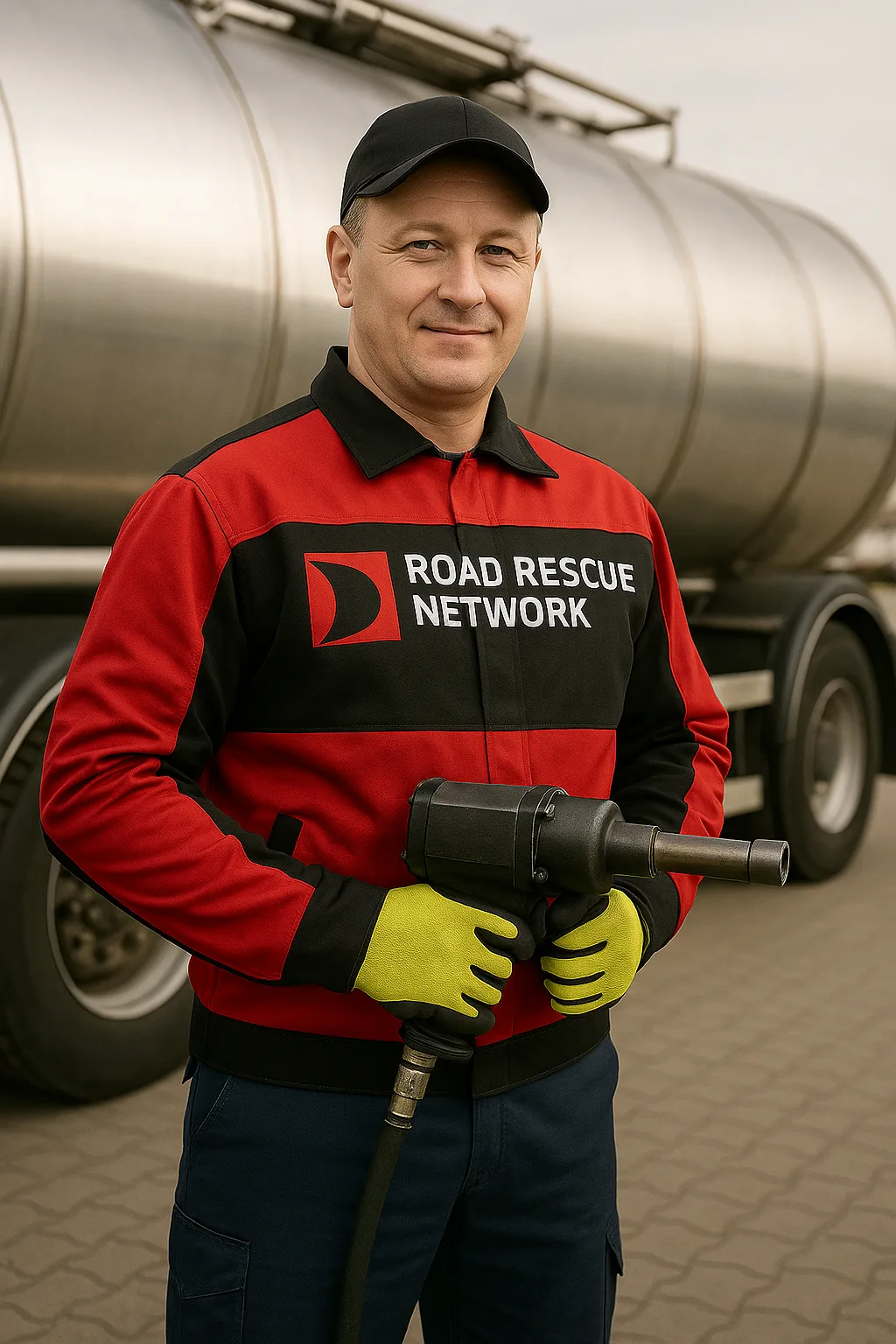
The gap between a mobile diesel technician and a mobile mechanic is mostly software and air tooling. A Elwood van without manufacturer-level diagnostics can read a code and cannot command a regen.
Engine and chassis OEM applications, multi-brand
Every fault-code and derate call. Generic readers show a code; OEM software commands regens, runs cutout tests, and reads live data.
Stationary regen command, soot and ash monitoring
Derate and aftertreatment calls, where this alone frequently ends the job on scene.
Gauges, line and fitting stock, dryer service
Anything that cannot build or hold air — a common, cheap, fast fix that otherwise becomes a tow.
Multimeter, clamp meter, load tester, wiring diagrams
No-crank, no-charge, and intermittent faults. Finds the ground or cable behind a fault blamed on a component.
Batteries, belts, hoses, sensors, filters, glad hands
Carried so the frequent failures finish on the first visit instead of turning into a parts run or a tow.
Priming equipment, filters, pressure testing
Run-dry and fuel starvation calls. A diesel run empty needs bleeding, which fuel alone does not accomplish.
Correct-spec coolant, oil, DEF
Leaks and top-offs, using the specification the engine actually calls for rather than what is nearest.
Scene lighting, cones, triangles, warning lights
Every live-roadway call. Working under a truck on a shoulder is the most dangerous part of this job.
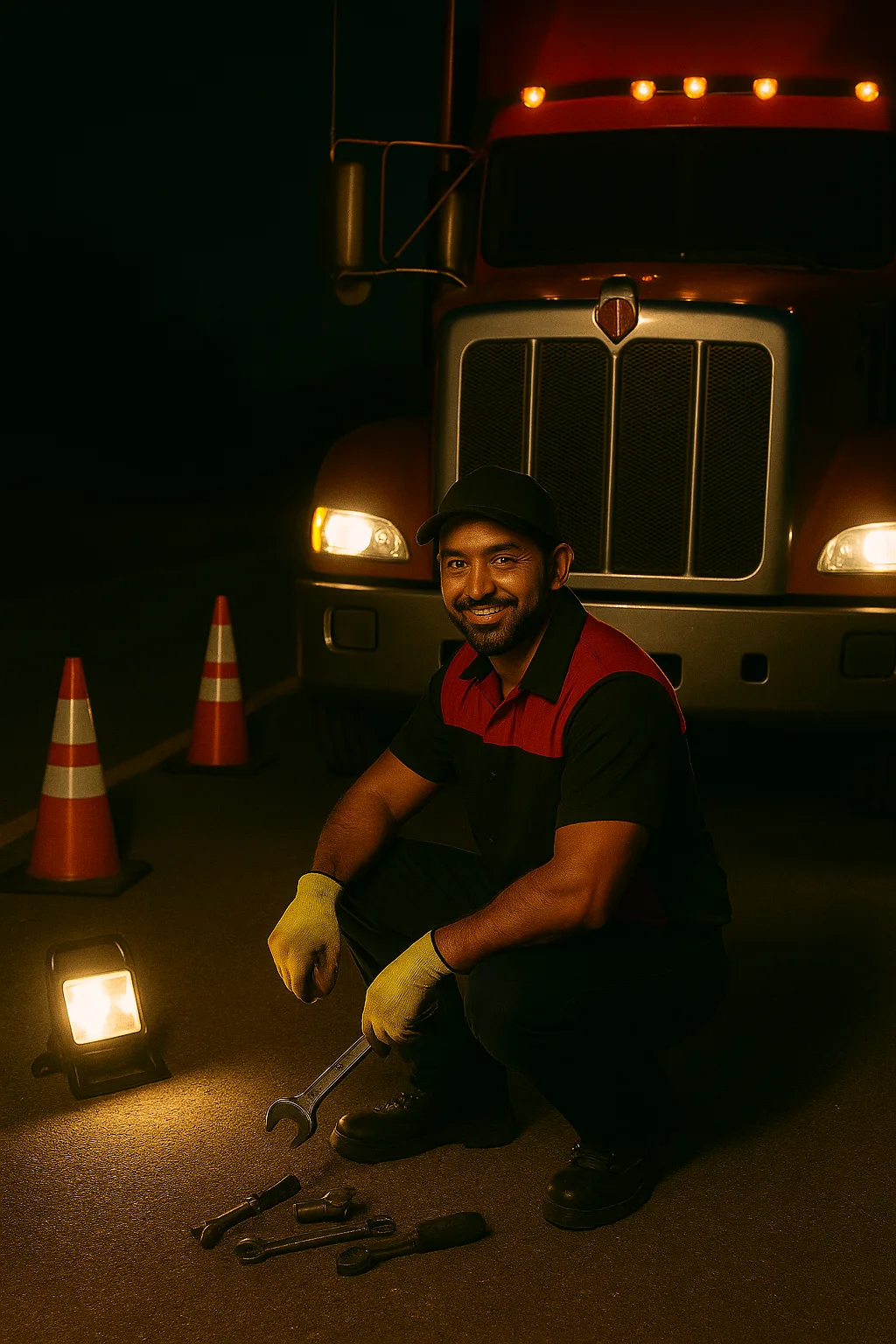
One call puts a mobile diesel mechanic unit on the road to you anywhere in Elwood and the surrounding Will County. Tell us where you are stopped and we do the rest.
A diesel technician dispatched to where the truck stopped across Elwood, with diagnostic software and the parts that end most calls on scene. The section at the bottom is the one nobody else publishes: what genuinely cannot be done outside a shop.
Reading the engine and chassis ECMs with manufacturer-level software rather than a generic code reader. A Elwood code names a circuit, not a part, and the difference is the whole job.
Injector cutout testing, high-pressure fuel faults, lift pumps, and filters. Fuel starvation and a failing injector present identically to a Elwood driver and not at all to a scan tool.
Variable-geometry actuators, sticking vanes, boost leaks, and charge-air cooler failures. The most common cause of a Elwood truck that runs but will not pull.
Water pumps, thermostats, fan clutches, radiators, and coolant leaks. A Elwood overheat that keeps driving stops being a roadside repair and becomes an engine.
Locating the actual source and reading whether low pressure is a sender, a pump, or something that means shut it down now. This is the call worth paying a Elwood technician to make correctly.
EGR valves, coolers, intake restriction, and crankcase ventilation. A blocked Elwood intake produces smoke and a derate that look like a dozen other things.
Commanding a stationary regen on scene when soot load has derated the truck. Frequently the entire Elwood repair, and it needs the software the manufacturer uses.
Dosers, pumps, quality sensors, and frozen or contaminated DEF. Bad fluid destroys the system it is supposed to protect anywhere in Elwood.
Sensor failures that derate a mechanically healthy truck. One of the highest-frequency Elwood aftertreatment faults and one of the cheapest to fix once identified.
A truck limited to a crawl is stranded in traffic terms. Identifying which countdown is running and clearing it correctly is what gets a Elwood driver moving legally.
Assessment of whether a filter can be cleaned or must be replaced. An ash-loaded Elwood filter will not regen no matter how many times it is commanded.
Repairs that keep the aftertreatment intact and functioning. Defeating emissions equipment is a federal violation carrying serious penalties, and no Elwood operator in this network will do it.
Starters, alternators, battery banks, and cable corrosion. A Elwood no-crank is frequently a cable or a ground rather than the expensive component it is blamed on.
Testing and replacement, plus finding the draw that kills a bank overnight. A jump that dies again in a Elwood truck stop was never the repair.
Compressors, dryers, governors, lines, and valves. A truck that cannot build air does not move, and this is usually cheap and fast once the leak is found in Elwood.
Chafed harnesses, corroded pins, and bad grounds behind intermittent faults. The Elwood problems that come back after somebody replaced the part the code named.
Clutch adjustment, linkage, u-joints, and driveline vibration. Adjustment and inspection happen roadside in Elwood; replacement generally does not.
Services, filters, and inspections performed in a Elwood yard on the fleet's schedule. Cheaper than the same work bought as an emergency later.
Rebuilds need a controlled environment, lifting equipment, and cleanliness no Elwood roadside can provide. Anyone offering one out of a van is not doing you a favor.
Removal and installation of major drivetrain assemblies needs a lift and support equipment. Diagnosis happens in Elwood; the replacement happens in a shop.
Anything requiring a press, a lathe, or precision measurement in a clean space. There is no mobile version of this work anywhere in Elwood.
Work under manufacturer warranty frequently has to route through an authorized dealer to preserve coverage. Confirm before authorizing a Elwood repair, because the wrong path voids it.
Frame straightening, collision repair, and paint. A Elwood mobile technician can make a truck safe to move and cannot make it straight.
The most valuable judgment on this list. A technician who tells you a Elwood truck needs a shop rather than billing hours on a roadside repair that will not hold has saved you the second dispatch.
Two of the four question boxes on this search ask what a mobile diesel mechanic charges per hour, and a page titled "Mobile Diesel Mechanic Prices" ranks on page one at zero authority. Here is the honest structure of a Elwood bill.
Bringing the technician, the software, and the parts to the truck. Billed once and separate from labor — this is what replaces a tow plus shop downtime, which is nearly always the larger number.
The dominant line. Mobile diesel labor generally prices between an independent shop and a dealership, and rates vary widely by market. Ask for the rate and the minimum before the truck rolls.
Most mobile operators bill a minimum — commonly an hour or two — whether or not the repair takes that long. Worth knowing up front rather than discovering on the invoice.
Charged as labor. On a derate or an intermittent electrical fault this is most of the visit, and it is also where the money is saved: the wrong guess replaces a good part.
Overnight, weekend, and holiday work carries a premium tier. Most breakdowns happen there, which is when the premium applies.
Mileage from the responding technician. A truck stop on a rural interstate costs more to reach than a metro yard for the identical repair.
Sensors, belts, filters, and air components are inexpensive and usually on the van. Injectors, turbos, aftertreatment components, and starters are not, and availability drives the timeline.
A forced regen is quick and cheap. A DPF replacement or an SCR component is one of the largest parts bills on a modern truck, and the two get confused constantly.
A live shoulder needs scene protection and sometimes a second unit. A yard or truck stop does not. Same repair, different cost.
Fleets on a standing arrangement generally see better rates and priority dispatch than a first-time emergency call. Worth setting up before you need it.
A stopped truck is losing revenue every hour and may be holding a load with a delivery window. This is why mobile usually wins on total cost even when the hourly rate looks higher than a shop's.
The largest saving is invisible. A roadside repair that returns a truck to service replaces a tow, a shop queue, and the days the truck sits in it.
Road Rescue Network does not set a member operator's rates. What the network does is send a technician with manufacturer-level diagnostics rather than a generic code reader, and get an honest call on scene about whether the truck can be repaired where it sits or belongs in a shop.
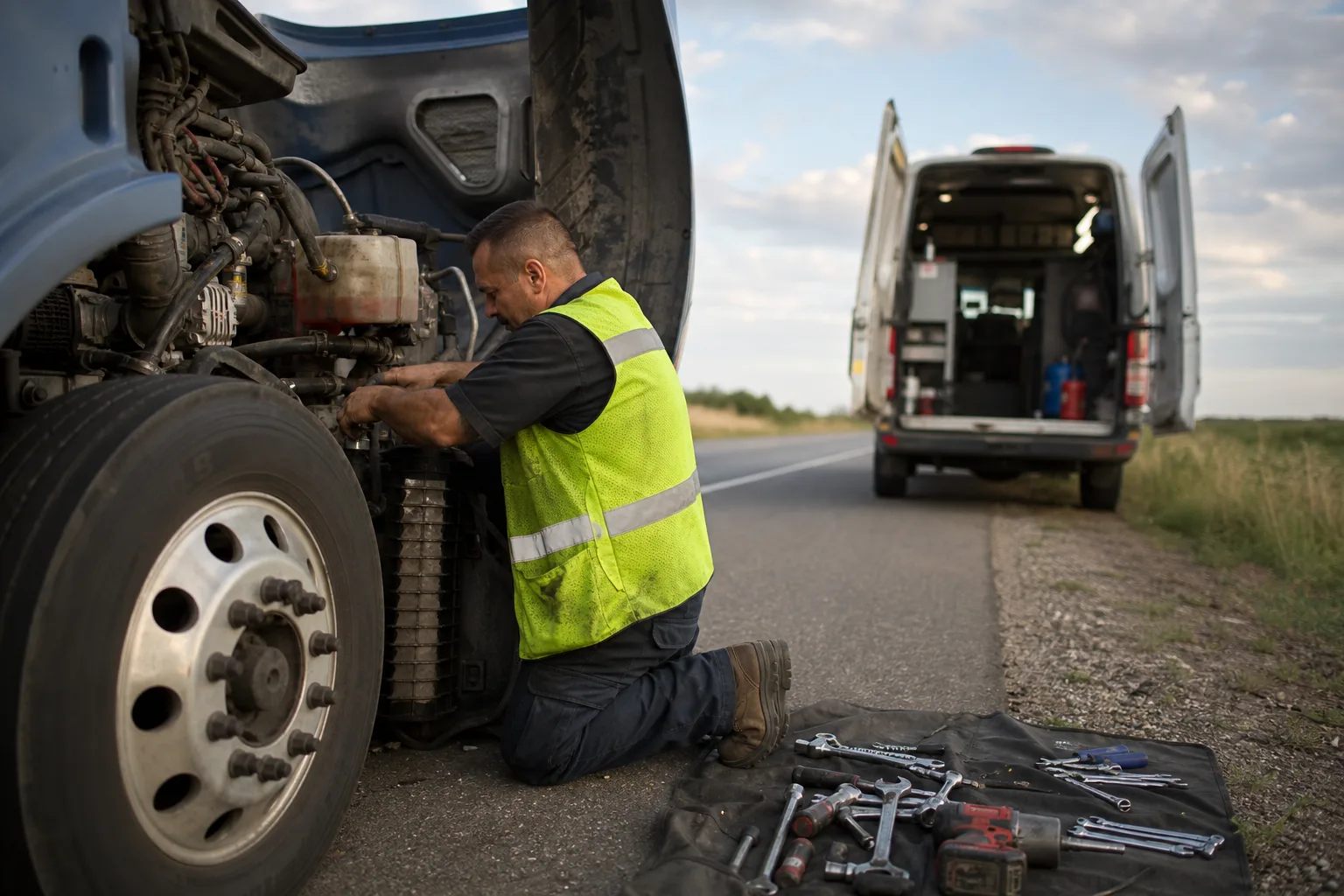
The same crews that run Elwood also cover Channahon (8 mi), Joliet (12 mi) and Minooka (6 mi), so a call from either side of Will County reaches the same desk.
Each service links to local response times, rescuer coverage, and recent dispatched jobs in this metro.
Patterns observed across recent dispatch data in this metro, by service type and corridor.
5:30 AM winter morning, minus-eight-degree ambient at Harbor Freight DC (Elwood). Loaded trailer from overnight freeze-check ready for 6 AM departure. Driver starts tractor; fuel lines gelled from sub-zero overnight cold. No engine cranking. RRN mobile fuel-system tech dispatches immediately (contacted by DC dispatch). Drains gelled fuel, flushes filter housing with heated solvent, installs new filter, delivers premium winter-grade diesel with anti-gel additive. Truck rolls by 6:15 AM, preserves national distribution schedule. DC postpones one backup tractor; no cascading delays.
Morning dock arrival, loaded tractor with time-sensitive shipment. Backup attempted; battery voltage collapses. RRN dispatches immediately with reserve battery. Mobile tech performs load-test, confirms battery failure (cold-rated battery too old for extreme cold). Swaps battery, cleans corrosion, applies terminal upgrade. Truck rolls within 18 minutes. Driver receives new battery recommendation; DC shifts load to backup unit if needed, minimal impact.
Heavy snow overnight, icy morning. Loaded tractor exiting Harbor Freight DC on County Road 48 hits unexpected ice, jackknifes. Trailer blocks warehouse gate access. RRN dual-unit recovery immediately mobilized. First unit chains tractor, second chains trailer. Coordinated extraction rights vehicles over 45 minutes. DC temporarily diverts outbound traffic to alternate staging area. No cargo damage; tractor towed to FleetPride (Chicago) for frame/suspension inspection. DC resumes normal outbound flow.
Truck departing Elwood on I-55 northbound toward Chicago distribution. Alternator bearing fails; no charging. Battery slowly discharges over 8 miles. Low-voltage warning lights; driver pulls to shoulder before losing all power. RRN mobile diagnostics arrives, confirms alternator failure. Loads battery to prevent stranding, coordinates controlled tow to FleetPride Chicago with priority bay. Load transferred to backup tractor at staging; on-time delivery preserved. RRN coordination prevents dock window loss.
County Road 48 to Harbor Freight DC congestion: multiple trucks queued for loading dock, stop-and-go over 2 miles. Transmission temperature climbs on one tractor. Driver notices delayed shifts; pulls aside before DC gate. RRN mobile tech checks transmission fluid (low) and cooler (salt-fouled). Top-off and cooler-line pressure test restore function. Truck advances into dock sequence; no rescheduling impact. Driver advised to schedule cooler flush and transmission service during maintenance window.
Trailer approaching Harbor Freight DC loading dock; air-brake pressure drops from 120 PSI to 75 PSI. Driver feels loss of brake response. Pulls aside on County Road 48 near warehouse. RRN air-brake tech dispatched; pressure-tests system, identifies slow leak in trailer supply line. Replaces damaged hose coupling with new assembly, recharges to spec. Pressure holds at 120 PSI. Truck resumes dock entry within 22 minutes; no load rescheduling.
Diesel repair sits under federal emissions law and federal safety-qualification rules at the same time. What governs the work in Elwood, Illinois.
Removing, disabling, or tampering with emissions control equipment — DPF, EGR, SCR — violates federal law, and enforcement has extended aggressively to the shops and technicians performing the work as well as the vehicle owners. Penalties are substantial, affected vehicles fail inspection, and no legitimate operator will perform a delete regardless of how the request is framed.
Federal rules require that anyone performing brake work on a commercial vehicle meet defined qualification standards through training or experience. This is not a formality — a brake repair performed by someone unqualified does not satisfy the requirement even if the work itself was competent.
Commercial vehicles require documented periodic inspection, and repairs affecting safety-critical systems belong in the maintenance file. Roadside repair records matter here: a fix with no paperwork is a fix that did not happen as far as an audit is concerned.
Drivers must report defects, and defects affecting safe operation must be corrected before the vehicle is dispatched again. A DVIR naming a defect creates a documented obligation to repair it, which is why roadside repairs frequently trace back to one.
A vehicle placed out of service at a roadside inspection cannot be moved until the defect is corrected. That is precisely when a mobile technician is worth more than a shop — the truck legally cannot come to the shop.
Repairs under manufacturer or extended warranty frequently must route through an authorized dealer to preserve coverage. Confirm coverage before authorizing a roadside repair, because the correct repair through the wrong channel can still void it.
You get a real time before anyone rolls, and the price before the work starts. No motor club runaround and no waiting on a callback.
Harbor Freight DC in Elwood drives regional and national distribution logistics. The distribution center operates 24/7, routing tools, equipment, and merchandise to retail stores across the Midwest and beyond. A single tractor breakdown at the loading dock or on access roads can back up 5–10 trailers scheduled for departure, multiplying delays nationally. Peak outbound windows (early morning, 6–8 AM, and afternoon, 2–4 PM) see 40–50 trucks staging for dispatch. Winter weather during peak windows can snarl the entire operation; RRN priority dispatch during sub-zero conditions is critical to maintaining distribution schedules.
Elwood is a village in rural Will County, Illinois, United States, approximately 45 miles southwest of Chicago. The population was 2,229 at the 2020 United States census, down from 2,279 in 2010.
Elwood is a small village of 2,229 residents 45 miles southwest of Chicago, but punches far above its weight as a regional distribution hub. Harbor Freight Tools Distribution Center (3401 S Brandon Rd) anchors the area as the primary employer, staging trucks for nationwide retail distribution. While Elwood itself has limited highway presence on state mapping, the village is adjacent to I-55 access and benefits from proximity to Joliet’s I-55/I-80 interchange zone. Local roads (Township Roads, County Routes) route trucks between the distribution center and I-55 ramps, creating a consistent stream of relay traffic toward Chicago’s warehouse district and regional markets. Breakdowns at or near Harbor Freight DC create urgent scheduling impacts; a disabled trailer can delay dozens of outbound shipments across the nation.
Winter weather in Elwood follows the Chicago metropolitan pattern: December through March brings ice storms, heavy snow, and sub-zero cold. The village’s rural setting provides less urban heat-island insulation; temperatures can drop 3–5 degrees lower than downtown Chicago on clear nights. Moisture from farm ponds and small waterways accelerates frost and black-ice formation on local road surfaces near distribution facilities. Salt application on access roads is lighter than urban zones; rural roads may become icy and treacherous. Battery failures and fuel gelling are more common here due to colder ambient; trucks staging overnight in frozen conditions face mechanical challenges.
Road Rescue Network serves Elwood with priority focus on Harbor Freight DC logistics and regional warehouse operations. We maintain 24/7 mobile dispatch for local roads connecting Elwood to I-55 and Joliet corridors. Vendor partnerships include River Valley Truck Parts (Kankakee), FleetPride Chicago, and independent shops trained in rapid-response warehouse emergencies. Winter-specialty services include fuel additives, battery exchange, and roadside diagnostics calibrated for sub-zero conditions. We coordinate directly with Harbor Freight logistics to preserve dock scheduling and minimize cargo staging delays during breakdowns. Our network extends into Channahon, Minooka, and the greater Will County warehouse cluster.
Mobile diesel labor is billed hourly, and the rate generally lands between an independent shop and a dealership — higher than a general mechanic because of the diagnostic software and the certification behind it. On top of the hourly rate, expect a service call or dispatch fee for bringing the technician and parts to the truck, and expect a minimum billing time, commonly an hour or two, whether or not the repair fills it. Overnight, weekend, and holiday calls carry a premium tier, and distance from the responding technician adds mileage. Rates vary widely by market, so the only figures that matter in Elwood are the ones you confirm before the truck rolls: hourly rate, minimum, service call fee, and whether diagnosis is quoted separately from repair. Road Rescue Network does not set a member operator's rates.
The structure is consistent even though the numbers are not: a service call fee, an hourly labor rate, a minimum billing time, parts, and premiums for after-hours or distance. Diesel and heavy-truck work prices above light-duty automotive work, because the tooling, the diagnostic software licences, and the qualification requirements are all heavier. The comparison people usually get wrong is against a shop's hourly rate alone — a shop rate excludes the tow to reach it and the days the vehicle sits in the queue, and for a commercial truck those two frequently exceed the entire repair. Ask any mobile operator for the rate, the minimum, and the call fee before authorizing, and ask for diagnosis and repair as separate lines.
Road Rescue Network dispatches mobile diesel technicians across Elwood and the surrounding Illinois area, to truck stops, terminal yards, docks, and roadside breakdowns, around the clock. What to look for in any provider, ours included: manufacturer-level diagnostic software rather than a generic code reader — that is what commands a forced regen and clears most derates on scene — qualification for brake work if brakes are involved, a written invoice listing parts and labor for your maintenance file, and a straight answer about whether the repair belongs roadside or in a shop. If the truck is under manufacturer warranty, confirm the repair channel first, because the right repair through the wrong channel can still void coverage.
There are real ones, and a provider who claims otherwise is worth less than one who names them. A van cannot do what a shop does: in-frame and engine overhauls, transmission or differential replacement, anything needing a press or a lift or machining, frame straightening, and paint are all shop work, full stop. Parts availability is narrower — a technician carries the common failures, so an unusual component means a delay a shop with a parts counter would not have. Weather and location constrain the work; there are repairs that simply should not be attempted on a live shoulder in the rain. Warranty repairs frequently have to route through an authorized dealer regardless of who is closer. And diagnostic depth has limits without a dynamometer or a lift. The trade is straightforward: for the large majority of breakdowns, mobile eliminates a tow and days of shop queue, and for the minority that genuinely need a bay, the right mobile technician tells you that instead of billing hours against it.
Usually yes, and it is one of the most common calls we run. A technician with manufacturer-level software can command a stationary regeneration on scene, which resolves a soot-loaded derate and returns the truck to full power. What it will not fix is a filter loaded with ash rather than soot — ash does not burn off, so no number of commanded regens will clear it and the filter needs cleaning or replacement. The same is true of a derate driven by a failed NOx sensor, a DEF quality fault, or a doser problem: those are component repairs, not regen candidates, and a good technician reads which one you have before commanding anything. A generic code reader can see the fault and cannot command the regen, which is the practical difference between a diesel technician and a mobile mechanic in Elwood.
No, and you should be wary of anyone who offers to. Removing or disabling emissions control equipment is a federal violation, and enforcement now routinely targets the shops and individual technicians performing the work as well as the vehicle's owner. The exposure is real: substantial civil penalties, a vehicle that fails inspection, resale problems, and liability that follows the equipment. There are also practical consequences people underestimate — many derates blamed on aftertreatment are actually sensor or DEF quality faults that are inexpensive to repair properly. No operator in this network performs deletes. What a technician will do is diagnose why the system is faulting and repair it, which is usually cheaper than the delete anyway.
Call RRN immediately and mention Harbor Freight DC Elwood. We coordinate directly with DC logistics and warehouse operations. For mobile-repairable issues (fuel, battery, air-brake diagnostics), we typically fix on-site within 20–30 minutes. For major work (transmission, engine), we arrange fast-track towing with backup tractor coordination so your load continues to national distribution. DC appreciates early notification; we can often preserve scheduling by offloading cargo to standby unit.
Yes. RRN maintains winter-grade diesel (treated with cold-flow enhancer) in mobile delivery tankers November through March. If you’re at Harbor Freight DC or anywhere in Elwood and fuel lines are gelling, call immediately. Average delivery response is 22 minutes. We can also deliver to local truck stops (Pilot Channahon, Minooka) for pre-fueling before winter hauls.
County Road 48 is rural with lighter salt maintenance than urban roads. Ice forms quickly during freeze events. Early morning (5–8 AM) is most treacherous due to overnight frost and reduced traffic to break ice. If you’re approaching the DC during freeze warnings, add 15–20 minutes to your ETA. RRN monitors County Road 48 conditions and provides emergency recovery if you jackknife or slide. Report hazards via app so we can alert other DC-bound trucks.
Absolutely. Harbor Freight DC typically has sub-zero startup challenges during January–February extremes. RRN pre-positions heated-battery reserves at staging areas near Elwood. Call with battery failure symptoms; we’ll deploy mobile tech with replacement within 18–20 minutes. Installed battery is tested under load before departure. Driver receives recommendation for battery upgrade if rated for less than 1000 CCA for your engine.
For mobile-repairable issues: 20–30 minutes (minimal impact). For major work: 2–4 hours (DC coordinates backup tractor, your load continues). RRN coordinates with DC dispatch to minimize rescheduling by offloading to standby unit or towing to priority-bay shop. Worst-case (multi-hour major repair): 6–8 hour delay, but RRN works to preserve your place in national distribution queues.
Elwood itself has no dedicated truck stop, but nearby: Pilot Travel Center (Channahon, 11 miles), Love’s (Channahon, 15 miles). Pilot Minooka (301 Ridge Rd) is 8 miles away. RRN can arrange overnight warehouse staging at Harbor Freight or nearby facilities if your load is compatible. For extended repairs, we coordinate with FleetPride Chicago or River Valley Truck Parts (Kankakee) with bay overnight staging.
Elwood doesn’t have a dedicated DOT station, but RRN coordinates inspections at Will County authorized facilities (Joliet area, 12 miles). Mobile pre-trip inspections for brake, lighting, tire, hazmat compliance average 24 minutes at Harbor Freight DC or roadside. Schedule in advance through app. For pre-departure checks at DC, we can often coordinate inspection at loading dock area.
Peak outbound (6–8 AM, 2–4 PM) creates stop-and-go queuing on County Road 48. Preventive: (1) Check transmission fluid monthly. (2) Monitor temperature gauge during dock staging. (3) Shift to neutral during extended stops. (4) Schedule cooler flush annually to remove salt/debris. If temperature climbs during staging, exit queue, cool 10 minutes, re-enter. RRN mobile diagnostics can check cooler condition roadside (28 min).
Call RRN immediately (5–30-min response). Mobile fuel-system tech will drain gelled fuel, flush filter, deliver winter-grade diesel with anti-gel. Truck typically rolls within 20–30 minutes. For future cold seasons, pre-treat all fuel loads with approved cold-flow additive and consider block heater installation. RRN can refer you to equipment vendors for engine-block heater setup.
Yes. Mobile air-brake service available on all local roads (County Road 48, I-55 access) and I-55 corridor from Elwood. Average response 30 minutes. Common issues: pressure loss from cold-weather moisture icing in compressor discharge, trailer supply-line leaks (salt corrosion), valve stiction. We carry replacement valves, hose couplings, and desiccant cartridges. Pressure-test confirms integrity before you roll.
Elwood runs about 2,229 people and sits in Will County, inside the Elwood Warehouse District (Chicago Metropolitan Extended). We take the call, find the closest crew that actually does this work, and tell you what it costs before anyone turns a wheel.
Coverage in surrounding cities and metros across the same network of verified rescuers.
The same verified network of providers, dispatched 24/7 across every major Illinois metro and freight corridor.
Whether the truck is sitting in Elwood or out toward Minooka, it is the same phone number and the same crews. One call, day or night.
Road Rescue Network is actively recruiting verified mobile diesel mechanic providers in the Elwood metro. Heavy traffic, real fleet leads, no auction race-to-the-bottom, straight rescuer-to-customer dispatch with confirmed pricing.
We send Elwood mobile diesel mechanic calls directly to verified rescuers in your service radius. Apply once. Insurance & DOT verified. Live dispatch, fleet accounts, transparent pricing, no motor-club shave-down.
Deep-dive guide on choosing the right provider, common pitfalls, and what to expect on a service call.
OpenOpen positions at our network rescuers, full-time, part-time, and 1099 contract.
OpenOn-site photos from recent calls, see the work, not just the marketing.
OpenNetwork technicians carry diagnostic equipment, OEM-spec tooling, and common-failure parts for every major mobile diesel mechanic brand on the road. Out-of-stock specifics order in within 24 hours.
Service trucks dispatch routinely to these locations across the metro freight corridors.


Local parts houses and diesel suppliers used by network mechanics for time-critical roadside repairs.
Major shippers, distribution centers, and industrial freight nodes generating outbound and inbound truck volume.
Three steps from the call to a cleared scene. Same flow whether you call from a fleet desk or the shoulder of an interstate.
Fault codes on the dash, whether it is derated, whether it will build air, and exact location. That set tells Elwood dispatch which technician and which parts, before anyone drives anywhere.
Manufacturer-level diagnostics, not a generic code reader — that is what commands a regen, runs an injector cutout, and reads live data. Most Elwood derates are cleared on scene by someone carrying it.
If it can be fixed where it sits, it gets fixed. If it needs a lift, a press, or a clean bay, we say so and tow it rather than bill Elwood hours against a repair that will not hold.
Network rescuers accept all major credit cards, fleet cards, and consumer payment apps. Confirmed at dispatch.